Sources. Thesis App. B.2 (the Kratos framework) and §4.3.3.5 (solution work-flow); code:
CMakeLists.txt,pyproject.toml,ContactStructuralMechanicsApplication.json,contact_structural_mechanics_application.{h,cpp},custom_python/*.cpp,python_scripts/search_base_process.py,python_scripts/auxiliary_methods_solvers.py,python_scripts/contact_structural_mechanics_static_solver.py,custom_processes/base_contact_search_process.{h,cpp},custom_strategies/custom_strategies/residualbased_newton_raphson_contact_strategy.h,custom_strategies/custom_convergencecriterias/base_mortar_criteria.h,custom_utilities/active_set_utilities.cpp;git logof the application folder.
The ContactStructuralMechanicsApplication (CSMA) is a plug-in of the StructuralMechanicsApplication: it does not define elements, constitutive laws or an analysis stage of its own. It adds the pieces that turn a structural problem into a contact problem, namely the interface conditions, the search that pairs them, the strategies and convergence criteria that drive the active set, and the Python glue that wires everything from a standard ProjectParameters.json. This page explains how these pieces are organised, how they are built, which data they share and in which order they are executed. The classes themselves are documented in the sibling pages: Conditions, Strategies and convergence criteria, Builder and solvers and linear solvers, Processes, Utilities, Frictional laws and MPC constraint and the Variables and flags reference.
Three layers
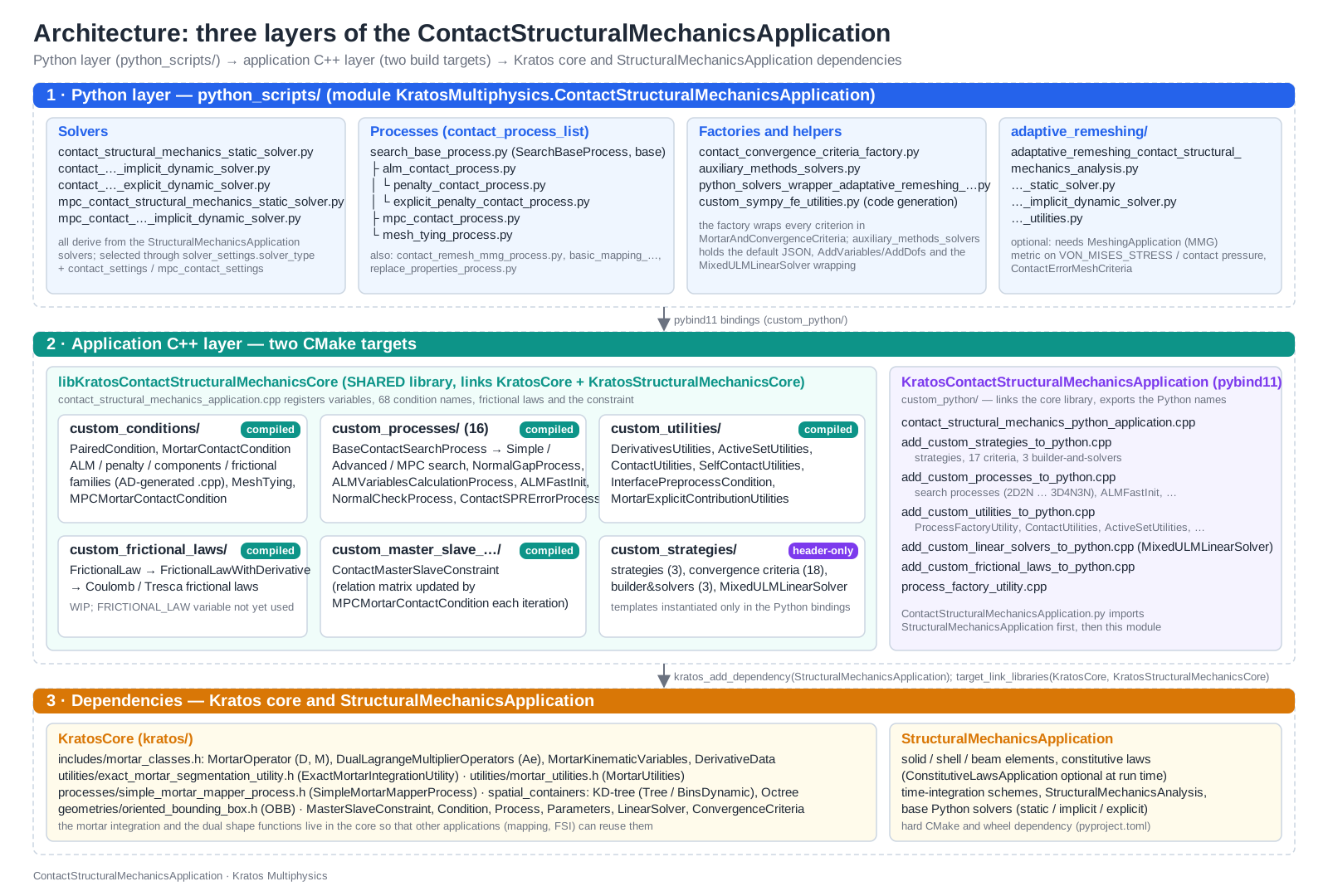
Figure: the Python layer, the application C++ layer (two CMake targets) and the Kratos core / StructuralMechanicsApplication dependencies.
| Layer | Where | What lives there | How it is reached |
|---|---|---|---|
| Python | python_scripts/ (installed as KratosMultiphysics.ContactStructuralMechanicsApplication) |
Contact solvers derived from the structural solvers (ContactStaticMechanicalSolver, ContactImplicitMechanicalSolver, ContactExplicitMechanicalSolver, MPCContactStaticSolver, MPCContactImplicitMechanicalSolver), the contact processes (SearchBaseProcess and its children ALMContactProcess, PenaltyContactProcess, ExplicitPenaltyContactProcess, MPCContactProcess, MeshTyingProcess), the convergence-criteria factory, the default-settings helpers (auxiliary_methods_solvers.py), the adaptive-remeshing analysis stage and the sympy utilities used for code generation |
Selected by the structural solver wrapper when solver_settings contains contact_settings or mpc_contact_settings, and by the contact_process_list of ProjectParameters.json |
| Application C++ | custom_conditions/, custom_processes/, custom_utilities/, custom_frictional_laws/, custom_master_slave_constraints/ (compiled) and custom_strategies/, custom_linear_solvers/ (header-only) |
Mortar conditions, contact search, active-set and derivative utilities, frictional laws, the MPC constraint, the contact strategies, 18 convergence criteria, 3 builder-and-solvers and the MixedULMLinearSolver |
Registered in KratosContactStructuralMechanicsApplication::Register() and exported to Python by the pybind11 module in custom_python/ |
| Kratos core + StructuralMechanicsApplication | kratos/ and applications/StructuralMechanicsApplication/ |
mortar_classes.h (MortarOperator, DualLagrangeMultiplierOperators, MortarKinematicVariables, DerivativeData), ExactMortarIntegrationUtility, MortarUtilities, SimpleMortarMapperProcess, KD-tree / octree spatial containers, OrientedBoundingBox, MasterSlaveConstraint, Condition, Process, Parameters; the solid/shell elements, constitutive laws, time schemes and StructuralMechanicsAnalysis |
kratos_add_dependency(StructuralMechanicsApplication) and target_link_libraries(... KratosCore KratosStructuralMechanicsCore) |
A design decision worth knowing when reading the code: the mortar machinery itself is not in this application. The mortar operators \(\mathbf{D}\) and \(\mathbf{M}\), the dual shape-function coefficient matrix \(\mathbf{A}_e\), the exact segmentation of a slave/master pair and the mortar mapper are Kratos-core classes (kratos/includes/mortar_classes.h, kratos/utilities/exact_mortar_segmentation_utility.h, kratos/utilities/mortar_utilities.h, kratos/processes/simple_mortar_mapper_process.h), so that the mapping and FSI applications can reuse them. What this application adds on top is the contact-specific use of those operators: the weak contact constraints, their consistent linearisation (custom_utilities/derivatives_utilities.h), the active-set logic and the search. See Mortar integration and dual Lagrange multipliers for the mathematics.
Folder-by-folder map
The application root applications/ContactStructuralMechanicsApplication/ contains the following (all paths relative to it; links point to the page that documents the folder in depth):
| Folder / file | Purpose | Documented in |
|---|---|---|
contact_structural_mechanics_application.{h,cpp} |
The KratosApplication subclass: builds the 68 condition prototypes (with Line2D2, Triangle3D3 and Quadrilateral3D4 geometries) in the constructor and registers conditions, the ContactMasterSlaveConstraint and all variables in Register() |
Conditions |
contact_structural_mechanics_application_variables.{h,cpp} |
Declaration/creation of the 34 application variables and the FrictionalCase and NormalDerivativesComputation enums |
Variables and flags reference |
ContactStructuralMechanicsApplication.py |
Python bootstrap: imports StructuralMechanicsApplication first, then _ImportApplication(KratosContactStructuralMechanicsApplication(), "KratosContactStructuralMechanicsApplication") |
this page |
CMakeLists.txt, pyproject.toml, ContactStructuralMechanicsApplication.json |
Build and packaging (see below) | this page |
custom_conditions/ |
PairedCondition, MortarContactCondition and the ALM / penalty / components / frictional / axisymmetric families (the large .cpp files are generated), MeshTyingMortarCondition, MPCMortarContactCondition |
Conditions |
automatic_differentiation/ |
The sympy generators (generate_*_mortar_condition.py), the *_template.cpp files with the BEGIN/END AD REPLACEMENT markers, the LaTeX derivations and per-folder READMEs |
Automatic differentiation |
custom_processes/ |
16 processes: the search hierarchy (BaseContactSearchProcess → SimpleContactSearchProcess / AdvancedContactSearchProcess / MPCContactSearchProcess, plus the two dimension-agnostic wrappers), NormalGapProcess, NormalCheckProcess, MasterSlaveProcess, ALMFastInit, ALMVariablesCalculationProcess, AALMAdaptPenaltyValueProcess, ComputeDynamicFactorProcess, AssignParentElementConditionsProcess, FindIntersectedGeometricalObjectsWithOBBContactSearchProcess, ContactSPRErrorProcess |
Processes, Search pipeline and bounding volumes |
custom_utilities/ |
ContactUtilities, ActiveSetUtilities, SelfContactUtilities, DerivativesUtilities, MortarExplicitContributionUtilities, InterfacePreprocessCondition, logging_settings.hpp |
Utilities |
custom_strategies/custom_strategies/ |
ResidualBasedNewtonRaphsonContactStrategy, LineSearchContactStrategy, ResidualBasedNewtonRaphsonMPCContactStrategy (header-only) |
Strategies and convergence criteria |
custom_strategies/custom_convergencecriterias/ |
BaseMortarConvergenceCriteria and its 5 active-set children, MortarAndConvergenceCriteria, the displacement / residual / mixed contact criteria (with LM and frictional variants), ContactErrorMeshCriteria, MPCContactCriteria (header-only) |
Strategies and convergence criteria |
custom_strategies/custom_builder_and_solvers/ |
ContactResidualBasedBlockBuilderAndSolver, ContactResidualBasedEliminationBuilderAndSolver, ContactResidualBasedEliminationBuilderAndSolverWithConstraints (header-only) |
Builder and solvers and linear solvers |
custom_linear_solvers/ |
MixedULMLinearSolver (header-only) |
Builder and solvers and linear solvers |
custom_frictional_laws/ |
FrictionalLaw → FrictionalLawWithDerivative → CoulombFrictionalLaw / TrescaFrictionalLaw |
Frictional laws and MPC constraint |
custom_master_slave_constraints/ |
ContactMasterSlaveConstraint |
Frictional laws and MPC constraint |
custom_python/ |
pybind11 bindings (one add_custom_*_to_python.cpp per category) and ProcessFactoryUtility |
this page (bindings map) |
python_scripts/ |
Solvers, processes, factories and helpers; adaptive_remeshing/ sub-package |
Solver settings reference, Contact process settings reference, Adaptive remeshing |
tests/ |
SmallTests.py, NightlyTests.py, ValidationTests.py, contact_structural_mechanics_test_factory.py, the data folders (ALM_frictionless_contact_test_2D, …, mesh_tying_test, mpc_contact_tests, penalty_*) and cpp_tests/ (gtests for conditions, linear solvers, processes and utilities) |
Test suite reference |
documents/doxyfile |
Doxygen configuration (PROJECT_NAME = "KratosMultiphysics - Contact Mechanics") |
– |
README.md, license.txt |
Overview and BSD licence | Overview |
Build layout
The CMakeLists.txt defines two targets:
KratosContactStructuralMechanicsCore— aSHAREDlibrary built from aGLOB_RECURSEofcontact_structural_mechanics_application.cpp,contact_structural_mechanics_application_variables.cpp,custom_utilities/*.cpp,custom_frictional_laws/*.cpp,custom_processes/*.cpp,custom_conditions/*.cppandcustom_master_slave_constraints/*.cpp. It linksPUBLIC KratosCore KratosStructuralMechanicsCoreand is compiled withCONTACT_STRUCTURAL_MECHANICS_APPLICATION=EXPORT,API(theKRATOS_API(CONTACT_STRUCTURAL_MECHANICS_APPLICATION)macro on every exported class).KratosContactStructuralMechanicsApplication— the pybind11 module (pybind11_add_module(... MODULE THIN_LTO ...)) built fromcustom_python/*.cpp, linkedPRIVATEagainst the core library, with an empty prefix and the.pyd/.sosuffix fix-ups for Windows and macOS.
Consequences of this split:
- Strategies, convergence criteria, builder-and-solvers and the linear solver are header-only templates (
custom_strategies/**,custom_linear_solvers/). There is no.cppfor them and they are not in the core library glob; their only instantiations are the ones requested byadd_custom_strategies_to_python.cppandadd_custom_linear_solvers_to_python.cppfor theUblasSpacesparse/local space pair. A C++ user of these classes includes the header directly. - Conditions, processes, utilities, frictional laws and the constraint are compiled into the core library, with explicit
template classinstantiations at the bottom of each.cppfor the geometry pairs<2,2>,<3,3>,<3,4>,<3,3,4>and<3,4,3>(times theFrictionalCaseand normal-variation combinations for the conditions). - Unity build exclusion. When
CMAKE_UNITY_BUILDis on,custom_utilities/interface_preprocess.cppand everycustom_conditions/*.cppare givenSKIP_UNITY_BUILD_INCLUSION TRUE(the batch size isKRATOS_UNITY_BUILD_BATCH_SIZE). The generated frictional condition alone is about 170 000 lines, so concatenating it with other translation units would explode compile memory;interface_preprocess.cppis excluded because of a conflict of explicit instantiations. - Tests. With
KRATOS_BUILD_TESTING=ON,tests/cpp_tests/*.cppare added throughkratos_add_gtests(TARGET KratosContactStructuralMechanicsCore ...). WithINSTALL_TESTING_FILES=ONthe wholetests/folder is installed underapplications/ContactStructuralMechanicsApplication/excluding*.c,*.h,*.cpp,*.hppand*.gitso that the Python tests find their reference and parameter files.KRATOS_BUILD_BENCHMARKwould buildbenchmarks/*.cppagainst Google Benchmark, but the folder does not currently exist. - Python install.
kratos_python_installcopiesContactStructuralMechanicsApplication.pytoKratosMultiphysics/ContactStructuralMechanicsApplication/__init__.pyandkratos_python_install_directoryinstallspython_scripts/as the package body (both honourINSTALL_PYTHON_USING_LINKS). The targets are appended toKRATOS_KERNELandKRATOS_PYTHON_INTERFACEin the parent scope.
Wheel packaging
pyproject.toml (hatchling backend) declares the wheel KratosContactStructuralMechanicsApplication, requires-python = ">=3.8", the dependencies KratosMultiphysics=={env:KRATOS_VERSION} and KratosStructuralMechanicsApplication=={env:KRATOS_VERSION}, and the binaries to ship in [kratos] libs (KratosContactStructuralMechanicsApplication.*, KratosContactStructuralMechanicsCore.*, libKratosContactStructuralMechanicsCore.*). The legacy ContactStructuralMechanicsApplication.json carries the same information for the older wheel scripts (excluded_binaries explicitly leaves libKratosStructuralMechanicsCore.* to the structural wheel). Neither the ConstitutiveLawsApplication (needed by some tests) nor the MeshingApplication (needed for adaptive remeshing, guarded at run time with kratos_utilities.CheckIfApplicationsAvailable("MeshingApplication")) is a build or wheel dependency.
Data model: model parts, properties and flags
A contact simulation manipulates the same ModelPart as the structural problem; the application adds sub-model-parts, non-historical values and flags to it. Everything is created by SearchBaseProcess (Python) and BaseContactSearchProcess (C++).
Sub-model-parts
| Name | Created by | Contents |
|---|---|---|
Contact |
SearchBaseProcess.ExecuteInitialize (main_model_part.CreateSubModelPart("Contact"), search_base_process.py:124-132); removed and recreated when the root model part Is(MODIFIED) after remeshing |
All interface nodes and the original skin conditions of every pair. It is what the search, the active-set utilities (rModelPart.GetSubModelPart("Contact") in active_set_utilities.cpp) and the convergence criteria iterate over. BaseContactSearchProcess raises an error if it does not exist |
ContactSub<key> |
SearchBaseProcess.__generate_search_model_part_from_input_list / __detect_skin (search_base_process.py:662-663, 725-726) |
One per pair "0" … "9" of the contact_model_part dictionary; holds the nodes and conditions of that pair (transferred with FastTransferBetweenModelPartsProcess) and its Properties (id 100 + key when contact_property_ids is 0). If the input lists are empty the skin is detected with SkinDetectionProcess2D/3D into ContactSub0 |
MasterSubModelPart<id_name>, SlaveSubModelPart<id_name> |
BaseContactSearchProcess::SetOriginDestinationModelParts (base_contact_search_process.cpp:237-254), inside the ContactSub<key> of the pair |
Nodes and conditions flagged MASTER / SLAVE; the master part is the origin and the slave part the destination of the SimpleMortarMapperProcess used by NormalGapProcess when check_gap is MappingCheck |
ComputingContact |
BaseContactSearchProcess constructor (base_contact_search_process.cpp:78-91) |
The pair conditions (MortarContactCondition instances) created by the search. This is the model part whose conditions are assembled: ContactUtilities::ComputeExplicitContributionConditions(rModelPart.GetSubModelPart("ComputingContact")) computes the gap, the block builder-and-solver checks it exists, and the MPC strategy toggles INTERACTION on its conditions |
ComputingContactSub<id_name> |
Same constructor | One per pair when id_name is not empty (MULTIPLE_SEARCHS local flag); the pair conditions of that search |
The pair conditions are created by name: the Python process gives the family stem (for example ALMFrictionlessMortarContact) as condition_name and the master node count as final_string ("4N" for a triangle/quadrilateral pair, "" otherwise), and the C++ search composes condition_name + "Condition" + TDim + "D" + TNumNodes + "N" + final_string (base_contact_search_process.cpp:94-101) and fetches the prototype from KratosComponents<Condition>. The ContactSearchWrapperProcess chooses the template instance (<2,2>, <3,3>, <3,4>, <3,3,4>, <3,4,3>) from DOMAIN_SIZE and the node counts of the first MASTER and SLAVE conditions it finds.
Properties and ProcessInfo
The processes push their settings into three places, which the conditions and utilities then read:
Propertiesof eachContactSub<key>:INTEGRATION_ORDER_CONTACT,CONSIDER_TESSELLATION,ACTIVE_CHECK_FACTOR(search_base_process.py:177-179, 407-408),FRICTION_COEFFICIENTper pair (alm_contact_process.py:474),TYING_VARIABLEfor mesh tying (mesh_tying_process.py:216), andTHICKNESSfor axisymmetric conditions (from the material).ProcessInfo:ZERO_TOLERANCE_FACTOR,ACTIVE_CHECK_FACTOR,DISTANCE_THRESHOLD(search),CONSIDER_NORMAL_VARIATION,ADAPT_PENALTY,MAX_GAP_FACTOR,OPERATOR_THRESHOLD,TANGENT_FACTOR,SLIP_AUGMENTATION_COEFFICIENT,SLIP_THRESHOLD,INITIAL_PENALTY,SCALE_FACTOR,ACTIVE_SET_CONVERGED(ALM process,alm_contact_process.py:373-447),REACTION_CHECK_STIFFNESS_FACTOR(MPC),MAX_GAP_THRESHOLD(explicit), and the countersNL_ITERATION_NUMBER,INNER_LOOP_ITERATIONmaintained by the strategy.- Nodal non-historical values (
SetValue):INITIAL_PENALTY,DYNAMIC_FACTOR,AUGMENTED_NORMAL_CONTACT_PRESSURE,AUGMENTED_TANGENT_CONTACT_PRESSURE,NODAL_AREA,NORMAL_GAP,FRICTION_COEFFICIENT; the historical variables and DoFs are added by the solver (AuxiliaryAddVariables/AuxiliaryAddDofs, see the Variables and flags reference).
Flags
Kratos flags are the main state mechanism of the application. Their meaning depends on the entity they are set on:
| Flag | On nodes | On conditions | On model parts / process info |
|---|---|---|---|
INTERFACE |
Node belongs to a contact interface (search_base_process.py:682) |
Original skin condition belongs to an interface (search_base_process.py:685); InterfacePreprocessCondition and NormalCheckProcess restrict themselves to INTERFACE entities |
– |
SLAVE / MASTER |
Side of the node (_assign_slave_flags / _assign_master_flags, then MasterSlaveProcess). ActiveSetUtilities only visit SLAVE nodes; MixedULMLinearSolver classifies DoFs with them |
Side of the skin condition; the search pairs SLAVE conditions with MASTER candidates (predefined_master_slave) |
– |
ACTIVE |
Node is in the active contact set (its NCP function says “in contact”); set by the search on creation and by ActiveSetUtilities every iteration |
Pair condition is active, that is at least one slave node is active (ContactUtilities::ActivateConditionWithActiveNodes); inactive pairs are skipped by the builder |
– |
SLIP |
Frictional state of an active node: set = slip, unset = stick (ActiveSetUtilities::ComputeALMFrictionalActiveSet) |
MPCMortarContactCondition uses it to select UpdateConstraintFrictional |
Main and Contact model parts: the problem is frictional (alm_contact_process.py:395-401); BaseContactSearchProcess, ALMFastInit, InterfacePreprocessCondition and BaseMortarConvergenceCriteria::PreCriteria read it |
ISOLATED |
Slave node whose pair conditions are all isolated: ContactResidualBasedBlockBuilderAndSolver::FixIsolatedNodes fixes its Lagrange-multiplier DoFs and FreeIsolatedNodes releases them (contact_residualbased_block_builder_and_solver.h:289-350) |
Pair condition whose segmentation produced no (or a negligible) integration area: CalculateConditionSystem sets it and zeroes the local system (mortar_contact_condition.cpp:422) |
– |
INTERACTION |
– | MPCMortarContactCondition::InitializeNonLinearIteration rebuilds its constraint only if the condition Is(INTERACTION) (mpc_mortar_contact_condition.cpp:183) |
Computing model part: full semi-smooth Newton when set (see below); process info in the MPC strategy |
CONTACT |
Node carries a contact constraint in ContactSPRErrorProcess |
– | Main model part: a contact process is present (alm_contact_process.py:393); the explicit solver scales DELTA_TIME by delta_time_factor_for_contact when the computing model part Is(CONTACT) |
RIGID |
– | MPCMortarContactCondition uses it to select UpdateConstraintTying (rigid coupling, that is mesh tying through constraints) |
Main model part in MPCContactProcess when the problem is tying rather than contact (mpc_contact_process.py:158-162) |
VISITED |
Bookkeeping in FixIsolatedNodes (visited slave nodes) |
Bookkeeping in FindIntersectedGeometricalObjectsWithOBBContactSearchProcess to avoid repeated intersections |
– |
MARKER |
Node that must not be deactivated by the search (base_contact_search_process.cpp:1508-1531), reset by SearchBaseProcess.ExecuteInitializeSolutionStep; also used by NormalCheckProcess to mark entities whose normal must be inverted |
Pair condition or constraint already visited in ClearMortarConditions / MPCContactSearchProcess |
– |
MODIFIED |
– | Frictional generated code: MODIFIED = non-objective slip formulation selected because the change of the mortar operators is below OPERATOR_THRESHOLD (ALM_frictional_mortar_contact_condition.cpp:201-205) |
Root / main model part: the mesh was remeshed, so SearchBaseProcess rebuilds the Contact sub-model-part and BaseContactSearchProcess clears everything (base_contact_search_process.cpp:1695) |
TO_ERASE |
– | Original skin conditions of the interface when regenerated after remeshing; pair conditions to be removed by ClearMortarConditions |
– |
BaseContactSearchProcess also defines local flags of its own (base_contact_search_process.h:102-106): INVERTED_SEARCH (search from master to slave), CREATE_AUXILIAR_CONDITIONS (a condition_name was given, so pair conditions are created), MULTIPLE_SEARCHS (an id_name was given), PREDEFINE_MASTER_SLAVE and PURE_SLIP. They are set from the JSON of the search in its constructor. Other classes with local flags are BaseMortarConvergenceCriteria (COMPUTE_DYNAMIC_FACTOR, IO_DEBUG, PURE_SLIP), the displacement/residual criteria (ENSURE_CONTACT, PRINTING_OUTPUT, TABLE_IS_INITIALIZED, ROTATION_DOF_IS_CONSIDERED, INITIAL_RESIDUAL_IS_SET, …) and MixedULMLinearSolver (BLOCKS_ARE_ALLOCATED, IS_INITIALIZED). The full list is in the Variables and flags reference.
Life cycle of a time step
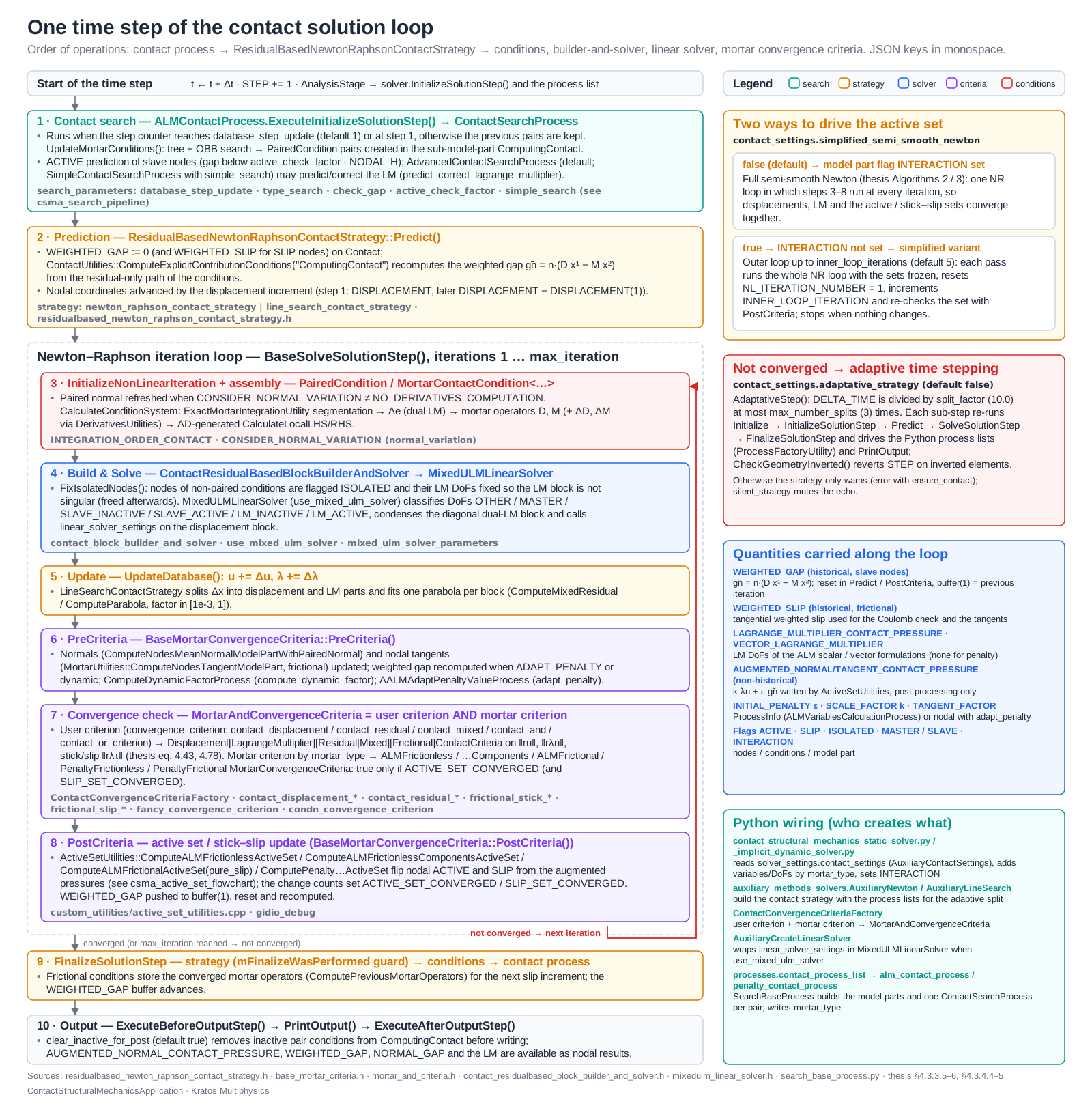
Figure: the contact solution loop of one time step (search, prediction, Newton iterations with active-set update, finalisation).
The plain workflow is a StructuralMechanicsAnalysis whose solver is one of the contact solvers and whose processes list contains a contact process. Within one time step the calls are:
SearchBaseProcess.ExecuteInitializeSolutionStep(search_base_process.py:211-241). If the current time is insideintervaland the step counter reacheddatabase_step_update(orSTEP == 1), the process resets theMARKERflags and callsExecuteInitializeSolutionStepof everyContactSearchProcess(one per pair). In C++ this isClearMortarConditions()followed byUpdateMortarConditions()(base_contact_search_process.cpp:181-189): the pair conditions of the previous step that are no longer close are removed fromComputingContact, the KD-tree / octree is rebuilt from the master conditions, every slave condition is queried, candidate pairs are filtered (normal orientation, gap check throughNormalGapProcesswhencheck_gapisMappingCheck) and newMortarContactConditioninstances are created and appended toComputingContact; slave nodes are pre-activated according toACTIVE_CHECK_FACTOR. When no search is due, the nodes and conditions of theContactsub-model-part are simply flagged notACTIVE. Details in Search pipeline and bounding volumes.- Strategy
InitializeSolutionStep(base Newton–Raphson): the builder-and-solver sets up the DoF set (reform_dofs_at_each_stepis forced totrueby the solvers because the set of active pairs changes every step) and callsInitializeSolutionStepon every condition;PairedCondition::InitializeSolutionSteprecomputes the cached master normalmPairedNormal, and the frictional conditions store the previous mortar operators for the slip increment. ResidualBasedNewtonRaphsonContactStrategy::Predict(residualbased_newton_raphson_contact_strategy.h:313-348): zeroesWEIGHTED_GAP(andWEIGHTED_SLIPwhen the model partIs(SLIP)) on theContactnodes, callsContactUtilities::ComputeExplicitContributionConditions("ComputingContact")so that every pair integrates its current weighted gap \(\tilde{g}_n\), and advances the nodal coordinates by the displacement increment (DISPLACEMENTin step 1,DISPLACEMENT - DISPLACEMENT(1)afterwards). No prediction of the multipliers is made here (that block is commented out);predict_correct_lagrange_multiplierin the search does it instead.SolveSolutionStep(residualbased_newton_raphson_contact_strategy.h:465-515). Two modes, chosen by theINTERACTIONflag of the computing model part (see next section). In both, each Newton iteration runs:InitializeNonLinearIteration(conditions recompute normals whenCONSIDER_NORMAL_VARIATIONrequests it) →MortarAndConvergenceCriteria::PreCriteria→ build and solve → update →PostCriteria. InsideBaseMortarConvergenceCriteria:PreCriteria(base_mortar_criteria.h:168-232) updates the nodal normals when normal variation is on, the nodal tangents for frictional problems, recomputes the weighted gap whenADAPT_PENALTYor a dynamic problem requires it, runsComputeDynamicFactorProcess(dynamic case withcompute_dynamic_factor) andAALMAdaptPenaltyValueProcess(adapt_penalty).PostCriteria(base_mortar_criteria.h:235-...) copiesWEIGHTED_GAPto the buffer, zeroes it, recomputes it withComputeExplicitContributionConditions, optionally dumps a GiD debug frame, and then calls the family-specific active-set update (ActiveSetUtilities::ComputeALMFrictionlessActiveSet,ComputeALMFrictionalActiveSet,ComputePenaltyFrictionlessActiveSet, …), which evaluates the augmented pressure \(\bar{\lambda}_n = k\lambda_n + \varepsilon\tilde{g}_n\) node by node, togglesACTIVE(andSLIP) and returns the number of changes. The step converges only when the user criterion (displacement,residual, …) and the active set (no node changed status) are both satisfied.
FinalizeSolutionStep: the strategy finalises (themFinalizeWasPerformedguard avoids doing it twice after an adaptive split), conditions runFinalizeSolutionStep(frictional ones resetmPreviousMortarOperatorsInitialized), and the solver optionally runsContactUtilities::CheckActivitywhenensure_contactis set. ThenSearchBaseProcess.ExecuteFinalizeSolutionStep(search_base_process.py:243-257) calls the C++ExecuteFinalizeSolutionStep, which clears the mortar conditions again when a search is due next step. The ALM process afterwards clears the augmented pressures of inactive nodes for post-processing (clear_inactive_for_post) and resets theSLIPflags everyslip_step_reset_frequencysteps.- Adaptive splitting (
adaptative_strategy): if the step did not converge,AdaptativeStep()dividesDELTA_TIMEbysplit_factorup tomax_number_splitstimes and re-runs the sequenceInitializeSolutionStep → Predict → SolveSolutionStep → FinalizeSolutionStepfor every sub-step, driving the user processes and output through theProcessFactoryUtilitylists (AddProcessesList/AddPostProcessof the solver).
The Algorithm-level description of the same loop (thesis Algorithm 2 for frictionless, Algorithm 3 for frictional) is in Frictionless contact and Frictional contact; the criteria are catalogued in Strategies and convergence criteria.
INTERACTION and simplified_semi_smooth_newton
Two ways of combining the Newton iterations with the active-set update exist, and the names are easy to confuse:
contact_settings.simplified_semi_smooth_newton |
Flag set by ContactStaticMechanicalSolver.Initialize (contact_structural_mechanics_static_solver.py:91-96) |
What SolveSolutionStep does |
Active-set check in ActiveSetUtilities |
|---|---|---|---|
false (default) |
computing_model_part.Set(INTERACTION, True) |
Full semi-smooth Newton: a single BaseSolveSolutionStep(); the active set is updated inside every Newton iteration through PostCriteria |
rModelPart.Is(INTERACTION) || NL_ITERATION_NUMBER == 1 is true for every iteration, so the set is re-evaluated each time (active_set_utilities.cpp:37, 90, 184, 226, 287) |
true |
computing_model_part.Set(INTERACTION, False) |
Simplified (nested) scheme: an outer loop of at most inner_loop_iterations passes; each pass resets NL_ITERATION_NUMBER = 1, sets INNER_LOOP_ITERATION, runs a complete Newton solve with a frozen active set and then calls PostCriteria to update the set; the outer loop stops when the set does not change |
The set is only re-evaluated at NL_ITERATION_NUMBER == 1, that is once per outer pass |
The MPC route uses the same flag on the process info (ResidualBasedNewtonRaphsonMPCContactStrategy, residualbased_newton_raphson_mpc_contact_strategy.h:425) and additionally sets INTERACTION on the ComputingContact conditions when update_each_nl_iteration is true, which makes MPCMortarContactCondition::InitializeNonLinearIteration rebuild the constraint relation matrix at every iteration.
Python bindings map
custom_python/contact_structural_mechanics_python_application.cpp defines the module KratosContactStructuralMechanicsApplication, calls the five AddCustom*ToPython functions, exposes the enum NormalDerivativesComputation and registers the variables (see the Variables and flags reference).
| Binding file | Exported names |
|---|---|
add_custom_strategies_to_python.cpp |
Strategies ResidualBasedNewtonRaphsonContactStrategy, LineSearchContactStrategy, ResidualBasedNewtonRaphsonMPCContactStrategy; criteria MortarAndConvergenceCriteria, MeshTyingMortarConvergenceCriteria, ALMFrictionlessMortarConvergenceCriteria, PenaltyFrictionlessMortarConvergenceCriteria, ALMFrictionlessComponentsMortarConvergenceCriteria, ALMFrictionalMortarConvergenceCriteria, PenaltyFrictionalMortarConvergenceCriteria, DisplacementContactCriteria, DisplacementLagrangeMultiplierContactCriteria, DisplacementLagrangeMultiplierFrictionalContactCriteria, DisplacementLagrangeMultiplierMixedContactCriteria, DisplacementLagrangeMultiplierMixedFrictionalContactCriteria, DisplacementResidualContactCriteria, DisplacementLagrangeMultiplierResidualContactCriteria, DisplacementLagrangeMultiplierResidualFrictionalContactCriteria, ContactErrorMeshCriteria, MPCContactCriteria; builder-and-solvers ContactResidualBasedBlockBuilderAndSolver, ContactResidualBasedEliminationBuilderAndSolver, ContactResidualBasedEliminationBuilderAndSolverWithConstraints |
add_custom_linear_solvers_to_python.cpp |
MixedULMLinearSolver |
add_custom_processes_to_python.cpp |
ALMFastInit, MasterSlaveProcess, ComputeDynamicFactorProcess, ALMVariablesCalculationProcess, ContactSPRErrorProcess2D, ContactSPRErrorProcess3D, ContactSearchProcess (the ContactSearchWrapperProcess), MPCContactSearchProcess (the MPCContactSearchWrapperProcess), NormalCheckProcess, FindIntersectedGeometricalObjectsWithOBBContactSearchProcess, AssignParentElementConditionsProcess, and the templated SimpleContactSearchProcess<S>, AdvancedContactSearchProcess<S>, MPCContactSearchProcess<S>, NormalGapProcess<S> for S in 2D2N, 3D3N, 3D4N, 3D3N4N, 3D4N3N |
add_custom_utilities_to_python.cpp |
ProcessFactoryUtility, ContactUtilities (static methods), InterfacePreprocessCondition, and the sub-modules ActiveSetUtilities and SelfContactUtilities |
add_custom_frictional_laws_to_python.cpp |
FrictionalLaw and FrictionalLaw<S>, TrescaFrictionalLaw<S>, CoulombFrictionalLaw<S> for the five geometry suffixes with and without the NV (normal variation) suffix |
process_factory_utility.{h,cpp} |
ProcessFactoryUtility: holds a Python list of processes and lets the C++ strategies call ExecuteInitializeSolutionStep, ExecuteFinalizeSolutionStep, ExecuteBeforeOutputStep, PrintOutput, … on them during adaptive splitting |
Everything else the user touches (contact_settings, contact_process_list) is pure Python in python_scripts/; the solvers are selected by StructuralMechanicsApplication/python_scripts/python_solvers_wrapper_structural.py, which maps the presence of contact_settings to contact_structural_mechanics_{static,implicit_dynamic,explicit_dynamic}_solver and of mpc_contact_settings to mpc_contact_structural_mechanics_{static,implicit_dynamic}_solver. See Getting started.
From ProjectParameters.json to objects
The two JSON blocks a user writes are consumed by different layers, and it helps to know who owns which key. solver_settings is read by the solver (Python), processes.contact_process_list by the contact process (Python), and both hand their values down to C++ objects through constructors, Parameters and the ProcessInfo:
ProjectParameters.json
├── solver_settings
│   ├── solver_type = "Static" | "Dynamic" (+ time_integration_method)   → python_solvers_wrapper_structural.py
│   ├── contact_settings { mortar_type, simplified_semi_smooth_newton,     → Contact*MechanicalSolver
│   │                      inner_loop_iterations, use_mixed_ulm_solver, …}   ├─ AuxiliaryAddVariables / AuxiliaryAddDofs (nodal DB)
│   │                                                                        ├─ ContactConvergenceCriteriaFactory → MortarAndConvergenceCriteria(...)
│   │                                                                        ├─ Contact*BuilderAndSolver, MixedULMLinearSolver
│   │                                                                        └─ ResidualBasedNewtonRaphsonContactStrategy(...)
│   └── mpc_contact_settings { contact_type, update_each_nl_iteration, … }  → MPCContact*Solver → ResidualBasedNewtonRaphsonMPCContactStrategy
└── processes.contact_process_list
    └── alm_contact_process | penalty_contact_process | explicit_penalty_contact_process
        | mpc_contact_process | mesh_tying_process                          → SearchBaseProcess subclasses
            ├─ model parts (Contact, ContactSub<k>), flags, Properties, ProcessInfo values
            ├─ InterfacePreprocessCondition, NormalCheckProcess, MasterSlaveProcess, ALMVariablesCalculationProcess, ALMFastInit
            └─ ContactSearchProcess / MPCContactSearchProcess (one per pair) → ComputingContact conditions / constraints
Two facts follow from this split:
contact_settings.mortar_typeis a user-provided key (the test cases set"ALMContactFrictionless","ALMContactFrictional","ALMContactFrictionalPureSlip","PenaltyContactFrictionless","PenaltyContactFrictional","ComponentsMeshTying", …) and must be consistent withcontact_type/ the process chosen incontact_process_list; nothing cross-checks them. It drives the nodal variables, the DoFs, the mortar convergence criterion and the use of theMixedULMLinearSolver.- The solver never sees the pair conditions: it only knows the computing model part. The process creates the
ComputingContactsub-model-part inside it, so the standard builder-and-solver loop overConditions()picks the mortar conditions up automatically.
What the contact solvers change with respect to the structural ones
| Method (all contact solvers) | Behaviour | Where |
|---|---|---|
__init__ |
Stores contact_settings (defaults from AuxiliaryContactSettings), then AuxiliarySetSettings raises buffer_size to at least 3 when "Frictional" is in mortar_type (the frictional conditions read DISPLACEMENT two steps back for the slip increment) |
auxiliary_methods_solvers.py:92-99 |
ValidateSettings |
Forces clear_storage = true and reform_dofs_at_each_step = true with an informative log line |
auxiliary_methods_solvers.py:109-120 |
AddVariables / AddDofs |
Adds NORMAL, NODAL_H and the formulation-specific historical variables and Lagrange-multiplier DoFs (table in the Variables and flags reference) |
auxiliary_methods_solvers.py:122-170 |
Initialize |
Silences the strategy when silent_strategy; sets the computing model part flag INTERACTION = not simplified_semi_smooth_newton |
contact_structural_mechanics_static_solver.py:84-96 |
ComputeDeltaTime |
Supports time_step, time_step_table and the legacy time_step_intervals; with inner_loop_adaptive the step is divided by the last INNER_LOOP_ITERATION count |
auxiliary_methods_solvers.py:180-212 |
ExecuteFinalizeSolutionStep |
Runs ContactUtilities.CheckActivity when ensure_contact is set (raises if no node is active) |
contact_structural_mechanics_static_solver.py:107-111 |
AddProcessesList / AddPostProcess |
Wrap the analysis-stage process lists in ProcessFactoryUtility objects so that the C++ strategy can drive them during adaptive splitting |
contact_structural_mechanics_static_solver.py:118-122 |
_CreateBuilderAndSolver |
"block" → ContactResidualBasedBlockBuilderAndSolver; "elimination" → ContactResidualBasedEliminationBuilderAndSolver or ...WithConstraints when multi_point_constraints_used |
contact_structural_mechanics_static_solver.py:138-156 |
_CreateSolutionStrategy |
solving_strategy_settings.type: newton_raphson → ResidualBasedNewtonRaphsonContactStrategy, line_search → LineSearchContactStrategy, arc_length → the structural arc-length strategy |
contact_structural_mechanics_static_solver.py:158-177 |
_CreateLinearSolver |
Optional ScalingSolver wrapper (rescale_linear_solver) and MixedULMLinearSolver wrapper (use_mixed_ulm_solver, only for ALMContactFrictional* and ALMContactFrictionlessComponents) |
auxiliary_methods_solvers.py:230-278 |
The implicit dynamic solver adds the same overrides on top of ImplicitMechanicalSolver; the explicit solver (ContactExplicitMechanicalSolver) uses the reduced AuxiliaryExplicitContactSettings block and multiplies its stable time step by delta_time_factor_for_contact while the computing model part Is(CONTACT).
Alternative routes
The default route described above (implicit, ALM or penalty, MortarContactCondition families) has three siblings that reuse most of the architecture:
| Route | Process | Solver / strategy | Interface objects | What differs |
|---|---|---|---|---|
| Explicit penalty | explicit_penalty_contact_process |
contact_structural_mechanics_explicit_dynamic_solver (central differences) |
PenaltyFrictionless… / PenaltyFrictional…MortarContactCondition |
No Newton loop; the conditions contribute through AddExplicitContribution (residual only, MortarExplicitContributionUtilities); the penalty is rescaled from MAX_GAP_THRESHOLD; the octree search is the default; NL_ITERATION_NUMBER is kept at 1 by the process |
| MPC contact | mpc_contact_process |
mpc_contact_structural_mechanics_{static,implicit_dynamic}_solver → ResidualBasedNewtonRaphsonMPCContactStrategy with its internal MPCContactCriteria |
MPCMortarContactCondition (zero LHS/RHS) + ContactMasterSlaveConstraint per pair, created by MPCContactSearchProcess |
No Lagrange-multiplier DoFs; the mortar operators build the constraint relation matrix \(\mathbf{D}^{-1}\mathbf{M}\) each iteration; the active set is decided from the mapped REACTION (tension check with REACTION_CHECK_STIFFNESS_FACTOR); SLIP / RIGID on the main model part switch between frictional, frictionless and tying constraints. See Frictional laws and MPC constraint |
| Mesh tying | mesh_tying_process |
Any contact solver with mortar_type ScalarMeshTying / ComponentsMeshTying |
MeshTyingMortarCondition |
Search executed once (database_step_update = 999999999), operators computed once in Initialize, no active set (the mortar criterion is MeshTyingMortarConvergenceCriteria). See Mesh tying |
| Adaptive remeshing | alm_contact_process + contact_remesh_mmg_process |
adaptative_remeshing_contact_structural_mechanics_analysis.py with the adaptive_remeshing/ solvers |
Same as default | The analysis stage remeshes with MMG between iterations, sets MODIFIED on the model part so that SearchBaseProcess rebuilds the Contact sub-model-part from scratch, re-initialises the solver and transfers slave data to the master. Requires the MeshingApplication. See Adaptive remeshing |
The time step as pseudo-code
The following condenses the previous sections into one block (implicit, ALM/penalty route; the names are the actual methods):
# --- StructuralMechanicsAnalysis.RunSolutionLoop, one step ---
time += ContactSolver.ComputeDeltaTime()              # inner_loop_adaptive may shrink it
SearchBaseProcess.ExecuteInitializeSolutionStep()     # if interval and database_step_update reached:
    ContactSearchProcess.ExecuteInitializeSolutionStep()   #   ClearMortarConditions(); UpdateMortarConditions()
                                                           #   -> pair conditions in "ComputingContact", nodes pre-ACTIVE
Strategy.InitializeSolutionStep()                     # SetUpDofSet (reform_dofs_at_each_step), conditions.InitializeSolutionStep
Strategy.Predict()                                    # WEIGHTED_GAP = 0; ComputeExplicitContributionConditions; x += Δu
Strategy.SolveSolutionStep():
    if model_part.IsNot(INTERACTION):                 # simplified_semi_smooth_newton = true
        for inner in 1..inner_loop_iterations:
            NL_ITERATION_NUMBER = 1; INNER_LOOP_ITERATION = inner
            converged = BaseSolveSolutionStep()       # Newton loop with frozen active set
            converged = criteria.PostCriteria(...)    # active-set update; stop when unchanged
    else:                                             # full semi-smooth Newton (default)
        converged = BaseSolveSolutionStep():
            repeat until converged or max_iteration:
                conditions.InitializeNonLinearIteration()      # normals if CONSIDER_NORMAL_VARIATION
                criteria.PreCriteria()                         # normals/tangents, dynamic factor, AALM penalty
                BuildAndSolve(); Update()                      # MortarContactCondition::CalculateLocalSystem
                converged = criteria.PostCriteria()            # user criterion AND active set unchanged
    if not converged and adaptative_strategy: converged = AdaptativeStep()
Strategy.FinalizeSolutionStep()                       # conditions.FinalizeSolutionStep; ensure_contact check
SearchBaseProcess.ExecuteFinalizeSolutionStep()       # ClearMortarConditions when a search is due next step
ALMContactProcess.ExecuteFinalizeSolutionStep()       # clear_inactive_for_post, slip_step_reset_frequency
OutputProcess.PrintOutput()
Registration and start-up
At import time ContactStructuralMechanicsApplication.py imports KratosMultiphysics.StructuralMechanicsApplication first (so that the structural variables and elements exist), then calls _ImportApplication on a KratosContactStructuralMechanicsApplication() instance. Its Register() (contact_structural_mechanics_application.cpp) performs, in order:
KRATOS_REGISTER_VARIABLE/KRATOS_REGISTER_3D_VARIABLE_WITH_COMPONENTSfor the 34 application variables (35 registration lines including the constraint).KRATOS_REGISTER_CONDITIONfor the 68 condition names built from the member prototypes (mMeshTyingMortarCondition2D2N,mALMFrictionlessMortarContactCondition2D2N, …). The prototypes are constructed in the application constructor with aCouplingGeometry-compatible signature(Id, pSlaveGeometry, pProperties, pMasterGeometry); see the Conditions page for the decoder.KRATOS_REGISTER_CONSTRAINT("ContactMasterSlaveConstraint", ...).
Strategies, criteria, builder-and-solvers and the linear solver are not registered in Register() (they are templates); they exist only as Python classes created by the solver scripts, and the strategies additionally carry a Name() ("newton_raphson_contact_strategy", "line_search_contact_strategy", "newton_raphson_mpc_contact_strategy") for the Kratos strategy factory.
Where is …? A quick index
| Looking for | Go to |
|---|---|
| The weak form, its linearisation and the generated local matrices | custom_conditions/*.cpp between the BEGIN/END AD REPLACEMENT banners; generators in automatic_differentiation/; Conditions, Automatic differentiation |
| The active-set decision (NCP function) | custom_utilities/active_set_utilities.cpp; called from the *_mortar_criteria.h PostCriteria; Frictionless contact |
| Where the pair conditions are created and destroyed | BaseContactSearchProcess::UpdateMortarConditions / ClearMortarConditions (custom_processes/base_contact_search_process.cpp); Search pipeline and bounding volumes |
| How the weighted gap \(\tilde{g}_n\) is computed outside the assembly | ContactUtilities::ComputeExplicitContributionConditions → MortarExplicitContributionUtilities::AddExplicitContributionOfMortarCondition; Gap computation |
| How the Lagrange multipliers are condensed out of the linear system | custom_linear_solvers/mixedulm_linear_solver.h; Builder and solvers and linear solvers |
| The penalty and scale-factor defaults | ALMVariablesCalculationProcess (custom_processes/alm_variables_calculation_process.cpp) driven by advance_ALM_parameters; Contact process settings reference |
| The list of every JSON key | Solver settings reference, Contact process settings reference |
| The list of every variable and flag | Variables and flags reference |
| The tests that exercise a given feature | Test suite reference |
Development timeline
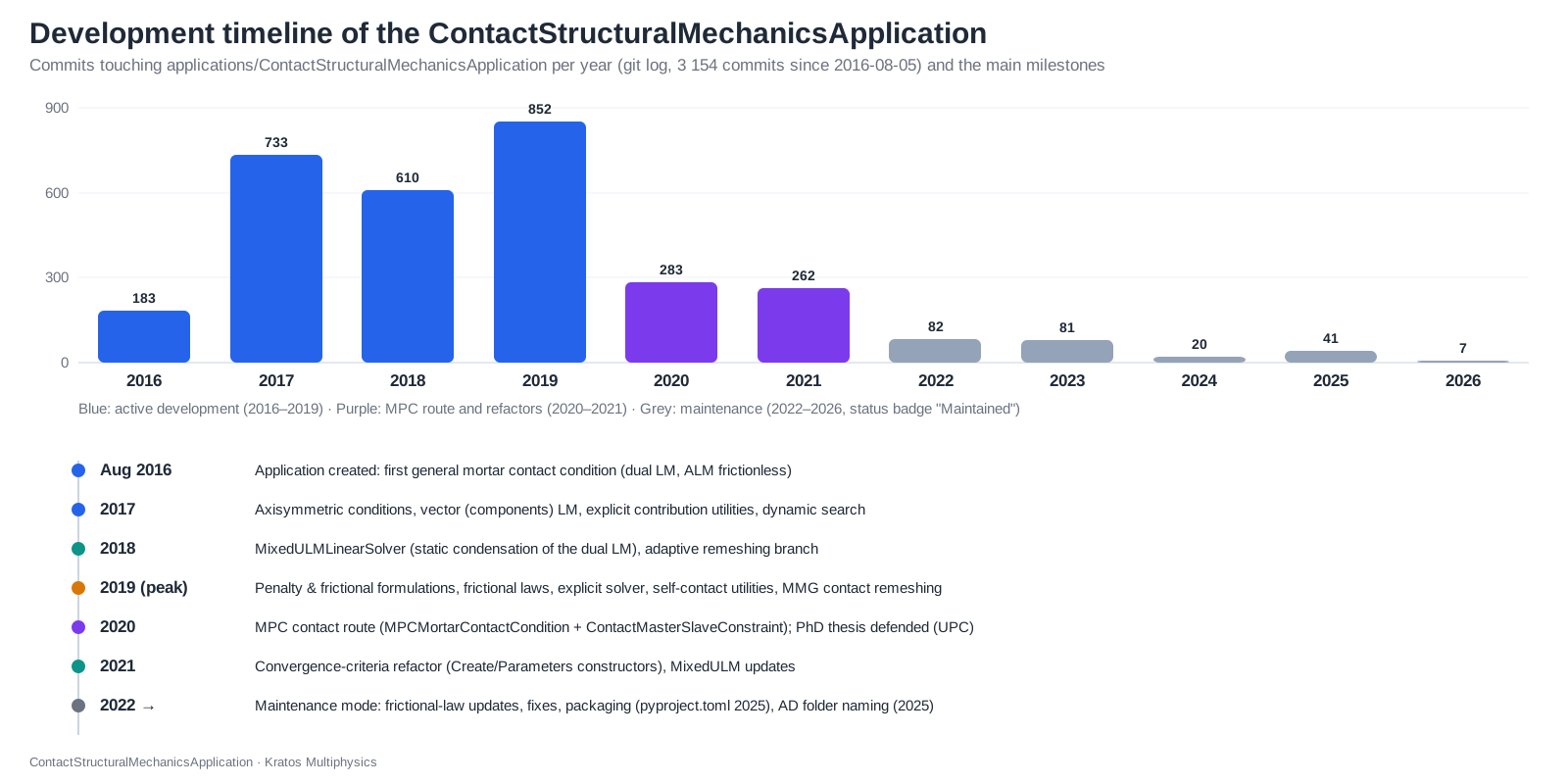
Figure: commits per year touching the application and the main milestones.
The application was created on 2016-08-05 (“Adding the new ContactStructuralMechanicsApplication until is stable enough to move to the StructuralMechanicsApplication or the ContactMechanicsApplication”) together with the first general mortar contact condition. Its git log counts 3 154 commits (as of this writing), distributed as follows:
| Year | 2016 | 2017 | 2018 | 2019 | 2020 | 2021 | 2022 | 2023 | 2024 | 2025 | 2026 |
|---|---|---|---|---|---|---|---|---|---|---|---|
| Commits | 183 | 733 | 610 | 852 | 283 | 262 | 82 | 81 | 20 | 41 | 7 |
Milestones (from the commit messages):
- 2016-08 — application created; general mortar contact condition.
- 2017–2018 — dual-mortar ALM frictionless formulation, automatic-differentiation code generation (
automatic_differentiation/), exact segmentation, search with KD-trees and bounding boxes, mesh tying, first benchmarks. - 2019-01 — penalty active-set criteria; explicit contact process, explicit solver and explicit test.
- 2019-04 — penalty frictional condition, frictional explicit contribution, new ALM frictional version (WIP).
- 2019-06 — first frictional laws (Coulomb/Tresca, WIP), derivatives for frictional laws, Hertz frictional tests.
- 2019-08 — specialised MMG remeshing script for contact (
contact_remesh_mmg_process.py). - 2019-09 — self-contact utilities, later improved with the
ACTIVEflag. - 2020-03 —
MPCContactSearchWrapperProcessand the MPC (constraint-based) contact route; the thesis is defended the same year. - 2021-05 — refactor of all convergence criteria (
Create+Parametersconstructors). - 2022 onwards — maintenance mode (API updates, bug fixes): 2025-10 DoF initialisation fix in
ResidualBasedNewtonRaphsonMPCContactStrategy; 2025-11 consistent naming inautomatic_differentiation/andpyproject.tomlfor all applications; 2026-08 latest fixes (size-comparison cast inMixedULMLinearSolver, unused coordinate variables inMPCMortarContactCondition).
The status badge of the application is therefore “Maintained” rather than “Actively developed”; see Tips, troubleshooting and limitations for the known limitations that follow from this.