Sources. Thesis §4.3.3.3 (ALM parameters), §4.3.3.6 and §4.3.4.5 (active and slip sets); code:
contact_structural_mechanics_application_variables.{h,cpp},contact_structural_mechanics_application.cpp(Register()),custom_python/contact_structural_mechanics_python_application.cpp:49-95,python_scripts/auxiliary_methods_solvers.py:122-170,python_scripts/search_base_process.py,python_scripts/alm_contact_process.py,python_scripts/mpc_contact_process.py,custom_processes/base_contact_search_process.h,custom_linear_solvers/mixedulm_linear_solver.h,custom_strategies/custom_convergencecriterias/*.h,custom_utilities/active_set_utilities.cpp,kratos/includes/variables.h,kratos/includes/mapping_variables.h,kratos/includes/mortar_classes.h.
The application communicates between its Python layer, its processes, its strategies and its conditions almost exclusively through variables (stored in the ProcessInfo, in the Properties of a pair, or on the nodes as historical or non-historical values) and through flags (on nodes, conditions and model parts). This page is the reference for all of them. It complements the Architecture page, which explains when they are set during a time step, and the Conditions page, which lists the subset consumed at assembly time. Nothing here is a user setting: the JSON keys that produce these values are documented in the Solver settings reference and the Contact process settings reference.
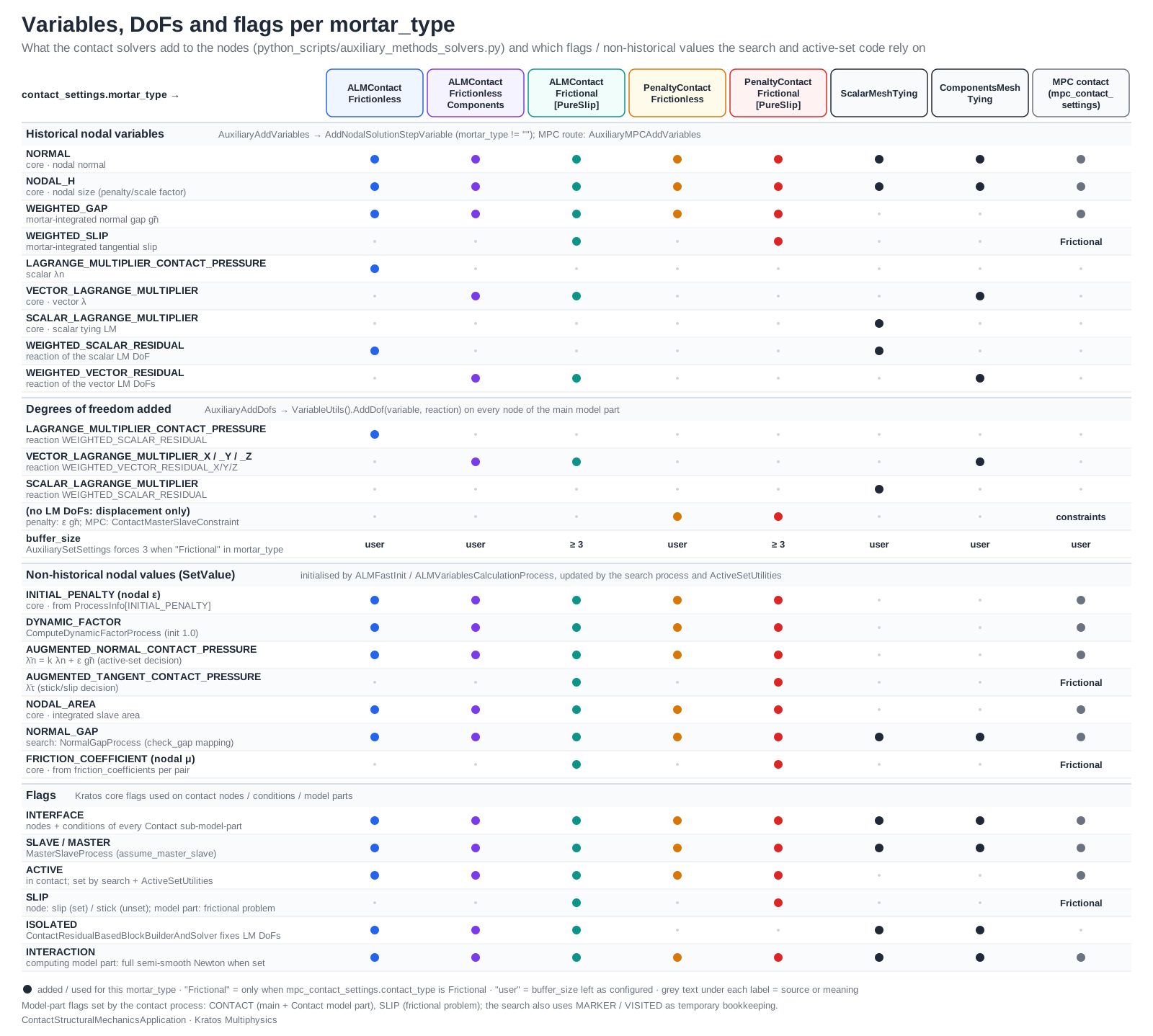
Figure: what each `mortar_type` adds to the nodes (historical variables and DoFs) and which non-historical values and flags the search and active-set code rely on.
Application variables
The 34 variables below are declared in contact_structural_mechanics_application_variables.h with KRATOS_DEFINE_APPLICATION_VARIABLE(CONTACT_STRUCTURAL_MECHANICS_APPLICATION, <type>, <NAME>) (or the _3D_..._WITH_COMPONENTS form, which also creates the _X, _Y, _Z components), created in contact_structural_mechanics_application_variables.cpp and registered in KratosContactStructuralMechanicsApplication::Register(). The group column follows the comment blocks of the header; storage tells where the value normally lives (PI = ProcessInfo, Prop = pair Properties, N-hist = nodal historical, N-val = nodal non-historical SetValue, C-val = condition SetValue). The “written by / read by” columns were obtained by searching every .h, .cpp and .py of the application (tests excluded).
MPC contact
| Variable | Type | Storage | Purpose | Written by | Read by |
|---|---|---|---|---|---|
CONSTRAINT_POINTER |
MasterSlaveConstraint::Pointer |
C-val | The ContactMasterSlaveConstraint owned by an MPCMortarContactCondition |
MPCContactSearchProcess when it creates a pair (custom_processes/mpc_contact_search_process.cpp) |
MPCMortarContactCondition (Initialize, InitializeSolutionStep, InitializeNonLinearIteration, ConstraintDofDatabaseUpdate), MPCContactCriteria, ResidualBasedNewtonRaphsonMPCContactStrategy |
REACTION_CHECK_STIFFNESS_FACTOR |
double |
PI | Factor applied to the reaction in the tension check that releases MPC-constrained nodes | MPCContactProcess (mpc_contact_process.py:339, from reaction_check_stiffness_factor) |
MPCContactCriteria |
Mortar general
| Variable | Type | Storage | Purpose | Written by | Read by |
|---|---|---|---|---|---|
CONSIDER_TESSELLATION |
bool |
Prop | Tessellate the clipped polygon instead of using the exact triangulation in ExactMortarIntegrationUtility |
SearchBaseProcess (search_base_process.py:180, from consider_tessellation) |
MortarContactCondition::CalculateConditionSystem, MeshTyingMortarCondition::Initialize, NormalGapProcess, MortarExplicitContributionUtilities |
INNER_LOOP_ITERATION |
int |
PI | Counter of the inner loop of the simplified semi-smooth Newton (INTERACTION not set) |
ResidualBasedNewtonRaphsonContactStrategy::SolveSolutionStep (residualbased_newton_raphson_contact_strategy.h:496, 511) |
auxiliary_methods_solvers.py:186-187 (convergence-criteria parameters) |
INTEGRATION_ORDER_CONTACT |
int |
Prop | Gauss order on every integration cell, 1–5 (default 2) | SearchBaseProcess (search_base_process.py:179, 409, from integration_order) |
GetIntegrationMethod of the mortar and mesh-tying conditions, CalculateConditionSystem, AddExplicitContribution of every family, MPCMortarContactCondition |
DISTANCE_THRESHOLD |
double |
PI | Maximum slave-master distance accepted by the segmentation and the gap mapper | SearchBaseProcess (search_base_process.py:405, fixed to 1.0e24) |
CalculateConditionSystem, AdvancedContactSearchProcess, NormalGapProcess, MPCContactCriteria, MortarExplicitContributionUtilities |
ZERO_TOLERANCE_FACTOR |
double |
PI | Multiplier of the machine epsilon used as geometric tolerance by the segmentation | SearchBaseProcess (search_base_process.py:391, from zero_tolerance_factor) |
CalculateConditionSystem, NormalGapProcess, MortarExplicitContributionUtilities |
ACTIVE_CHECK_FACTOR |
double |
PI and Prop | Fraction of the nodal size NODAL_H below which a node is activated by the search (thesis §4.4) |
SearchBaseProcess (search_base_process.py:392, 410, from search_parameters.active_check_factor) |
BaseContactSearchProcess (base_contact_search_process.cpp:654, 766), AdvancedContactSearchProcess |
SLIP_THRESHOLD |
double |
PI | Threshold on the augmented tangential pressure that separates stick from slip in the active-set update | ALMContactProcess (alm_contact_process.py:413, frictional only) |
ActiveSetUtilities::ComputeALMFrictionalActiveSet (active_set_utilities.cpp:293) |
AUXILIAR_COORDINATES (+ _X/_Y/_Z) |
array_1d<double,3> |
N-val | Coordinates used by the gap mapper (MappingCheck) as origin of the projection |
NormalGapProcess (normal_gap_process.cpp:40-49) |
NormalGapProcess (through SimpleMortarMapperProcess); dumped by the debug_mode GiD output |
DELTA_COORDINATES (+ _X/_Y/_Z) |
array_1d<double,3> |
N-val | Predicted displacement increment used to move the nodes before a dynamic search | ContactUtilities::ComputeStepJump (contact_utilities.cpp:114) |
BaseContactSearchProcess (base_contact_search_process.cpp:463, 545, 1416), ContactUtilities (debug check at l. 232) |
NORMAL_GAP |
double |
N-val | Geometric (not integrated) normal gap of a slave node, obtained by projection or mapping | NormalGapProcess, BaseContactSearchProcess, SimpleContactSearchProcess, AdvancedContactSearchProcess |
ActiveSetUtilities, ComputeDynamicFactorProcess, the search (check_gap) |
TANGENT_SLIP (+ _X/_Y/_Z) |
array_1d<double,3> |
N-val | Geometric tangential slip | nobody (only a commented-out debugging block in active_set_utilities.cpp:116-118) |
nobody; registered and exposed but currently unused |
Weighted (mortar-integrated) quantities
| Variable | Type | Storage | Purpose | Written by | Read by |
|---|---|---|---|---|---|
WEIGHTED_GAP |
double |
N-hist | Integrated (weighted) normal gap \(\tilde{g}_{n,j} = \mathbf{n}_j \cdot (\mathbf{D}\mathbf{x}^{(1)} - \mathbf{M}\mathbf{x}^{(2)})_j\) of slave node \(j\) | MortarExplicitContributionUtilities::AddExplicitContributionOfMortarCondition / ...FrictionalCondition (called through AddExplicitContribution of every condition, mortar_explicit_contribution_utilities.cpp:153, 329); reset by ALMFastInit and BaseContactSearchProcess |
ActiveSetUtilities, BaseMortarConvergenceCriteria and every mortar criteria, ResidualBasedNewtonRaphsonContactStrategy::Predict, AALMAdaptPenaltyValueProcess, ComputeDynamicFactorProcess, CoulombFrictionalLaw, MPCMortarContactCondition, MPCContactCriteria, AdvancedContactSearchProcess |
WEIGHTED_SLIP (+ _X/_Y/_Z) |
array_1d<double,3> |
N-hist | Integrated tangential slip increment of a slave node | AddExplicitContributionOfMortarFrictionalCondition (mortar_explicit_contribution_utilities.cpp:338); reset by ALMFastInit, BaseContactSearchProcess |
ActiveSetUtilities::ComputeALMFrictionalActiveSet, frictional criteria, MPCMortarContactCondition::CalculateRightHandSide, MPCContactCriteria, ContactUtilities |
WEIGHTED_SCALAR_RESIDUAL |
double |
N-hist | Reaction of the scalar multiplier DoF (LAGRANGE_MULTIPLIER_CONTACT_PRESSURE or SCALAR_LAGRANGE_MULTIPLIER) |
the builder-and-solver, as reaction variable of the DoF (auxiliary_methods_solvers.py:160, 166) |
BaseContactSearchProcess (reset), MeshTyingProcess |
WEIGHTED_VECTOR_RESIDUAL (+ _X/_Y/_Z) |
array_1d<double,3> |
N-hist | Reaction of the vector multiplier DoFs (VECTOR_LAGRANGE_MULTIPLIER_X/Y/Z) |
the builder-and-solver (auxiliary_methods_solvers.py:162-164, 168-170) |
BaseContactSearchProcess (reset), MeshTyingProcess |
The two residual variables exist only because VariableUtils().AddDof(variable, reaction, model_part) requires a reaction variable; the # TODO Remove WEIGHTED_SCALAR_RESIDUAL in case of check for reaction is defined comments in auxiliary_methods_solvers.py:159, 161 acknowledge that no criterion reads them.
Augmented Lagrangian method
| Variable | Type | Storage | Purpose | Written by | Read by |
|---|---|---|---|---|---|
ACTIVE_SET_COMPUTED |
bool |
PI | Guard so that the active set is evaluated once per iteration even if several criteria are combined | BaseMortarConvergenceCriteria (base_mortar_criteria.h:306, 390, reset to false), the ALM mortar criteria (set to true after the check, e.g. alm_frictional_mortar_criteria.h:201) |
the ALM mortar criteria and the displacement_lagrangemultiplier_*_frictional_contact_criteria |
ACTIVE_SET_CONVERGED |
bool |
PI | Result of the active-set check (no node changed status) | ALMContactProcess / MPCContactProcess (initialized to true, alm_contact_process.py:375, mpc_contact_process.py:338), the ALM and penalty mortar criteria (alm_frictional_mortar_criteria.h:199) |
the same criteria (PostCriteria) |
SLIP_SET_CONVERGED |
bool |
PI | Result of the stick/slip check | ALMFrictionalMortarConvergenceCriteria (alm_frictional_mortar_criteria.h:200) |
ALMFrictionalMortarConvergenceCriteria (l. 206) |
OPERATOR_THRESHOLD |
double |
PI | Threshold on the Frobenius norm of \(\mathbf{D}-\mathbf{D}_{old}\) and \(\mathbf{M}-\mathbf{M}_{old}\) that selects the objective slip formulation | ALMContactProcess (alm_contact_process.py:380, from operator_threshold) |
generated AugmentedLagrangianMethodFrictionalMortarContactCondition::CalculateLocalLHS/RHS (ALM_frictional_mortar_contact_condition.cpp:201) |
SLIP_AUGMENTATION_COEFFICIENT |
double |
PI | Coefficient that augments the tangential pressure with the slip in the stick/slip decision | ALMContactProcess (alm_contact_process.py:412) |
ActiveSetUtilities::ComputeALMFrictionalActiveSet (active_set_utilities.cpp:294) |
DYNAMIC_FACTOR |
double |
N-val | Nodal factor multiplying the displacement equations of the contact condition in dynamics to account for the gap evolution within the step | ComputeDynamicFactorProcess, initialized to 1 by ALMFastInit |
generated code of all five families (GetVariableVector(slave, DYNAMIC_FACTOR)), BaseMortarConvergenceCriteria (COMPUTE_DYNAMIC_FACTOR) |
LAGRANGE_MULTIPLIER_CONTACT_PRESSURE |
double |
N-hist (DoF) | Scalar normal multiplier \(\lambda_n\) of the ALMContactFrictionless formulation |
the linear solver (it is a DoF); predicted by ResidualBasedNewtonRaphsonContactStrategy::Predict; reset by the search and ALMFastInit |
generated frictionless code (LMNormal), ActiveSetUtilities::ComputeALMFrictionlessActiveSet, ContactResidualBasedBlockBuilderAndSolver::FixIsolatedNodes, the displacement/LM criteria, BaseMortarConvergenceCriteria (output) |
AUGMENTED_NORMAL_CONTACT_PRESSURE |
double |
N-val | Augmented normal pressure \(\bar{\lambda}_n = k \lambda_n + \varepsilon \tilde{g}_n\) (divided by the nodal area for output) | ActiveSetUtilities (frictionless and frictional active-set functions); zeroed by ALMFastInit and ALMContactProcess (alm_contact_process.py:198, 281) |
CoulombFrictionalLaw::GetThresholdValue, ContactSPRErrorProcess, BaseMortarConvergenceCriteria (output), ALMContactProcess / MPCContactProcess (total contact force, alm_contact_process.py:257-258), the adaptive-remeshing scripts |
AUGMENTED_TANGENT_CONTACT_PRESSURE (+ _X/_Y/_Z) |
array_1d<double,3> |
N-val | Augmented tangential pressure of a frictional node | ActiveSetUtilities::ComputeALMFrictionalActiveSet; zeroed by ALMFastInit |
BaseMortarConvergenceCriteria (output), ALMContactProcess (debug output) |
CONSIDER_NORMAL_VARIATION |
int |
PI | Integer cast to NormalDerivativesComputation (see enums) that controls the normal update and the normal derivatives |
ALMContactProcess (alm_contact_process.py:373, 407, from normal_variation) |
PairedCondition::InitializeNonLinearIteration, MortarContactCondition::CalculateConditionSystem, BaseMortarConvergenceCriteria |
ADAPT_PENALTY |
bool |
PI | Whether the adapted augmented Lagrangian (AALM) penalty update is active | ALMContactProcess (alm_contact_process.py:378, from advance_ALM_parameters.adapt_penalty) |
BaseMortarConvergenceCriteria::PreCriteria (runs AALMAdaptPenaltyValueProcess) |
MAX_GAP_FACTOR |
double |
PI | Ratio between NODAL_H and the maximum admissible gap used when re-scaling the penalty |
ALMContactProcess (alm_contact_process.py:379) |
AALMAdaptPenaltyValueProcess, ComputeDynamicFactorProcess |
Mesh tying, explicit and frictional laws
| Variable | Type | Storage | Purpose | Written by | Read by |
|---|---|---|---|---|---|
TYING_VARIABLE |
std::string |
Prop | Name of the variable tied by MeshTyingMortarCondition (default "DISPLACEMENT") |
MeshTyingProcess (mesh_tying_process.py:216) |
MeshTyingMortarCondition::Initialize (mesh_tying_mortar_condition.cpp:72-100) |
PARENT_ELEMENT |
Element::Pointer |
C-val | Element attached to a skin condition (intended for mesh tying with static condensation) | AssignParentElementConditionsProcess (assign_parent_element_conditions_process.cpp:72) |
nobody else in the application |
MAX_GAP_THRESHOLD |
double |
PI | Gap above which the explicit penalty is re-scaled | ExplicitPenaltyContactProcess (explicit_penalty_contact_process.py:134-137, from advance_explicit_parameters.max_gap_threshold or the mean NODAL_H) |
ComputeDynamicFactorProcess |
FRICTIONAL_LAW |
FrictionalLaw::Pointer |
– | Intended holder of the frictional law of a pair | nobody | nobody; the conditions read FRICTION_COEFFICIENT nodally instead (Frictional laws and MPC constraint) |
TRESCA_FRICTION_THRESHOLD |
double |
Prop, N-val or PI | Constant tangential threshold of the Tresca law | user / Python | TrescaFrictionalLaw::GetThresholdValue (properties, then node, then process info) |
Note. Three variables (
TANGENT_SLIP,PARENT_ELEMENT,FRICTIONAL_LAW) are registered but have no consumer in the current code base, andFRICTIONAL_LAWis not even written. They are kept for compatibility and for the planned frictional-law refactoring.
Kratos-core variables used by the application
These variables are defined in kratos/includes/variables.h (or mapping_variables.h for TANGENT_FACTOR) and are therefore available as KratosMultiphysics.<NAME> in Python; they play a central role in the formulation.
| Variable | Type | Storage | Role in the contact application | Written by | Read by |
|---|---|---|---|---|---|
SCALE_FACTOR |
double |
PI | Scale factor \(k\) of the multiplier equations, so that \(k \lambda_n\) has the magnitude of a stress-like stiffness term (thesis §4.3.3.3, Tables 4.1–4.2) | ALMContactProcess (alm_contact_process.py:437-447: from ALMVariablesCalculationProcess when advance_ALM_parameters.manual_ALM is false, otherwise advance_ALM_parameters.scale_factor; forced to 1 when zero), MeshTyingProcess |
DerivativeData::Initialize (mortar_classes.h:710, feeds the generated code), MeshTyingMortarCondition (LHS/RHS), ActiveSetUtilities, CoulombFrictionalLaw, BaseContactSearchProcess |
BUILD_SCALE_FACTOR |
double |
PI | Fallback scale of the mesh-tying condition when SCALE_FACTOR is absent |
the block builder-and-solver of the core when use_block_builder scaling is on |
MeshTyingMortarCondition::CalculateLocalLHS/RHS |
INITIAL_PENALTY |
double |
PI and N-val | Penalty \(\varepsilon\) of the augmented Lagrangian / penalty formulations; the process-info value is the global default, the nodal value the one actually used | ALMContactProcess, PenaltyContactProcess, ExplicitPenaltyContactProcess (process info, alm_contact_process.py:440-445, penalty_contact_process.py:244-251); ALMFastInit and ExplicitPenaltyContactProcess (nodal, explicit_penalty_contact_process.py:279); adapted by AALMAdaptPenaltyValueProcess |
DerivativeData::Initialize (mortar_classes.h:709, PenaltyParameter[i] = node.GetValue(INITIAL_PENALTY)), ActiveSetUtilities, ComputeDynamicFactorProcess, CoulombFrictionalLaw, ResidualBasedNewtonRaphsonContactStrategy |
FRICTION_COEFFICIENT |
double |
Prop and N-val | Coulomb coefficient \(\mu\) per pair (properties) copied to the slave nodes | ALMContactProcess / MPCContactProcess (alm_contact_process.py:473-474, mpc_contact_process.py:399-400, from friction_coefficients), ALMFastInit (nodal copy) |
GetFrictionCoefficient() of the frictional conditions, MPCMortarContactCondition::CalculateRightHandSide, ActiveSetUtilities, FrictionalLaw::GetFrictionCoefficient |
TANGENT_FACTOR |
double |
PI | Ratio between tangential and normal penalty in the stick equations (mapping_variables.h:401: “The factor between the tangent and normal behaviour”) |
ALMContactProcess / MPCContactProcess (alm_contact_process.py:411, mpc_contact_process.py:367, from tangent_factor) |
DerivativeDataFrictional::Initialize (mortar_classes.h:960), ActiveSetUtilities |
NODAL_H |
double |
N-hist | Nodal mesh size; reference length for the search radius, the active check and the ALM parameter estimation | FindNodalHProcess (core), run by SearchBaseProcess |
ALMVariablesCalculationProcess, AALMAdaptPenaltyValueProcess, BaseContactSearchProcess, ContactUtilities, ExplicitPenaltyContactProcess |
NORMAL |
array_1d<double,3> |
N-hist and C-val | Nodal (averaged) and condition (face) unit normals of the interface | NormalCalculationUtils (core) through SearchBaseProcess / BaseContactSearchProcess; inverted where needed by NormalCheckProcess |
every condition (GetValue(NORMAL) for the slave face, FastGetSolutionStepValue(NORMAL) for the nodes in DerivativeData), ActiveSetUtilities, NormalGapProcess, MPCMortarContactCondition |
NODAL_AREA |
double |
N-val | Slave nodal area (sum of the integrated dual weights) used to normalize weighted quantities into pressures/gaps | MortarExplicitContributionUtilities::ComputeNodalArea and the penalty AddExplicitContribution; reset by ExplicitPenaltyContactProcess (explicit_penalty_contact_process.py:172) |
ActiveSetUtilities, MPCMortarContactCondition, ComputeDynamicFactorProcess, AdvancedContactSearchProcess, ALMFastInit, ALMContactProcess (total force) |
NODAL_PAUX, NODAL_MAUX |
double |
N-val | Auxiliary nodal weights of the MPC route (PAUX = slave side, MAUX = master side) used to scale the constraint rows and the mapped reactions |
ResidualBasedNewtonRaphsonMPCContactStrategy (residualbased_newton_raphson_mpc_contact_strategy.h:828-831, reset), MPCContactCriteria |
MPCMortarContactCondition::UpdateConstraint* (1/NODAL_PAUX), MPCContactCriteria |
REACTION |
array_1d<double,3> |
N-hist | Displacement reactions; in the MPC route they carry the contact force of the constrained slave nodes | the builder-and-solver | MPCContactCriteria (tension check, mpc_contact_criteria.h:250, 281), MPCMortarContactCondition::CalculateRightHandSide (slip force), ALMContactProcess / MPCContactProcess (output of the total reaction) |
CONTACT_FORCE |
array_1d<double,3> |
N-val | Normal contact force recovered from REACTION in the MPC route |
MPCContactCriteria (mpc_contact_criteria.h:165, 260) |
post-processing |
CONTACT_PRESSURE |
double |
N-val | Fallback contact pressure used by the SPR error estimator when AUGMENTED_NORMAL_CONTACT_PRESSURE is missing |
user / other applications | ContactSPRErrorProcess (contact_spr_error_process.cpp:134-198), adaptive remeshing |
VECTOR_LAGRANGE_MULTIPLIER (+ _X/_Y/_Z) |
array_1d<double,3> |
N-hist (DoF) | Vector multiplier \(\boldsymbol{\lambda}\) of the ALMContactFrictional, ALMContactFrictionlessComponents and ComponentsMeshTying formulations |
the linear solver; predicted by the strategy; reset by the search and ALMFastInit |
generated frictional / components code, MeshTyingMortarCondition, ActiveSetUtilities, CoulombFrictionalLaw, MixedULMLinearSolver, the LM criteria |
SCALAR_LAGRANGE_MULTIPLIER |
double |
N-hist (DoF) | Scalar multiplier of ScalarMeshTying |
the linear solver | MeshTyingMortarCondition, BaseContactSearchProcess, SimpleContactSearchProcess |
THICKNESS |
double |
Prop | Thickness used by the axisymmetric conditions in \(2\pi r/t\) | the material JSON | the four *AxisymCondition classes |
DISPLACEMENT, VELOCITY, ACCELERATION |
array_1d<double,3> |
N-hist | Kinematics; the frictional families need three buffer positions of DISPLACEMENT (u1old = u(1) - u(2), mortar_classes.h:962) |
the structural solver | DerivativeData, ContactUtilities::ComputeStepJump, CheckIsolatedElement (commented), BaseMortarConvergenceCriteria (dynamic factor) |
DELTA_TIME, STEP, NL_ITERATION_NUMBER |
double, int, int |
PI | Time-step bookkeeping; STEP == 1 switches DerivativeData::Initialize to absolute displacements; NL_ITERATION_NUMBER drives the convergence tables and the Predict of the strategy |
the analysis stage and the strategy | conditions, criteria, processes |
ERROR_RATIO |
double |
PI | Estimated error ratio of the SPR estimator | ContactSPRErrorProcess |
ContactErrorMeshCriteria |
Nodal variables and DoFs added by the solvers
The contact solvers call AuxiliaryAddVariables(main_model_part, mortar_type) inside AddVariables and AuxiliaryAddDofs(main_model_part, mortar_type) inside AddDofs (python_scripts/auxiliary_methods_solvers.py:122-170), on top of what the structural solver adds (DISPLACEMENT, REACTION, VELOCITY, ACCELERATION, …). NORMAL and NODAL_H are added for every non-empty mortar_type; the MPC solvers use AuxiliaryMPCAddVariables (l. 150-156) instead and add no multiplier DoF.
mortar_type |
Historical variables added | DoFs added (reaction variable) | Conditions that use it |
|---|---|---|---|
ALMContactFrictionless |
NORMAL, NODAL_H, LAGRANGE_MULTIPLIER_CONTACT_PRESSURE, WEIGHTED_GAP, WEIGHTED_SCALAR_RESIDUAL |
LAGRANGE_MULTIPLIER_CONTACT_PRESSURE (WEIGHTED_SCALAR_RESIDUAL) |
ALM[NV]Frictionless[Axisym]MortarContactCondition* |
ALMContactFrictionlessComponents |
NORMAL, NODAL_H, VECTOR_LAGRANGE_MULTIPLIER, WEIGHTED_GAP, WEIGHTED_VECTOR_RESIDUAL |
VECTOR_LAGRANGE_MULTIPLIER_X/Y/Z (WEIGHTED_VECTOR_RESIDUAL_X/Y/Z) |
ALM[NV]FrictionlessComponentsMortarContactCondition* |
ALMContactFrictional (also the ALMContactFrictionalPureSlip variant, matched with "ALMContactFrictional" in mortar_type) |
NORMAL, NODAL_H, VECTOR_LAGRANGE_MULTIPLIER, WEIGHTED_GAP, WEIGHTED_SLIP, WEIGHTED_VECTOR_RESIDUAL |
VECTOR_LAGRANGE_MULTIPLIER_X/Y/Z (WEIGHTED_VECTOR_RESIDUAL_X/Y/Z) |
ALM[NV]Frictional[Axisym]MortarContactCondition* |
PenaltyContactFrictionless |
NORMAL, NODAL_H, WEIGHTED_GAP |
none | Penalty[NV]Frictionless[Axisym]MortarContactCondition* |
PenaltyContactFrictional (and its PureSlip variant) |
NORMAL, NODAL_H, WEIGHTED_GAP, WEIGHTED_SLIP |
none | Penalty[NV]Frictional[Axisym]MortarContactCondition* |
ScalarMeshTying |
NORMAL, NODAL_H, SCALAR_LAGRANGE_MULTIPLIER, WEIGHTED_SCALAR_RESIDUAL |
SCALAR_LAGRANGE_MULTIPLIER (WEIGHTED_SCALAR_RESIDUAL) |
MeshTyingMortarCondition* with a scalar TYING_VARIABLE |
ComponentsMeshTying |
NORMAL, NODAL_H, VECTOR_LAGRANGE_MULTIPLIER, WEIGHTED_VECTOR_RESIDUAL |
VECTOR_LAGRANGE_MULTIPLIER_X/Y/Z (WEIGHTED_VECTOR_RESIDUAL_X/Y/Z) |
MeshTyingMortarCondition* with DISPLACEMENT |
MPC solvers (AuxiliaryMPCAddVariables, contact_type) |
NORMAL, NODAL_H, WEIGHTED_GAP (+ WEIGHTED_SLIP if Frictional) |
none | MPCMortarContactCondition* |
The multiplier DoFs are added to all nodes of the main model part (VariableUtils().AddDof(..., main_model_part)); the block builder-and-solver fixes the ones that do not belong to an active slave node (Builder and solvers and linear solvers). Because the frictional formulations difference the displacement over two previous steps, the contact solvers raise the minimum buffer size to 3 for ALMContactFrictional* and PenaltyContactFrictional* (Solver settings reference).
Enumerations
| Enum | Defined in | Enumerators | Used for | Python |
|---|---|---|---|---|
FrictionalCase |
contact_structural_mechanics_application_variables.h:46-52 |
FRICTIONLESS = 0, FRICTIONLESS_COMPONENTS = 1, FRICTIONAL = 2, FRICTIONLESS_PENALTY = 3, FRICTIONAL_PENALTY = 4 |
Template parameter TFrictional of MortarContactCondition, DerivativesUtilities, MortarExplicitContributionUtilities and the frictional laws; selects MatrixSize, the derivative-data type and the multiplier DoFs (Conditions) |
not exposed (compile-time only) |
NormalDerivativesComputation |
contact_structural_mechanics_application_variables.h:57-62 |
NO_DERIVATIVES_COMPUTATION = 0, ELEMENTAL_DERIVATIVES = 1, NODAL_ELEMENTAL_DERIVATIVES = 2, NO_DERIVATIVES_COMPUTATION_WITH_NORMAL_UPDATE = 3 |
Value of CONSIDER_NORMAL_VARIATION: 0 freezes the normals within the step; 1 and 2 linearize the normals (elemental only, or nodal averaged from the elemental ones) and update them every iteration; 3 updates them without derivatives |
KratosMultiphysics.ContactStructuralMechanicsApplication.NormalDerivativesComputation (contact_structural_mechanics_python_application.cpp:49-54); ALMContactProcess maps the normal_variation string (no_derivatives_computation, elemental_derivatives, nodal_elemental_derivatives, no_derivatives_computation_with_normal_update) to it |
BaseContactSearchProcess::SearchTreeType |
custom_processes/base_contact_search_process.h:115-122 |
KdtreeInRadius = 0, KdtreeInBox = 1, KdtreeInRadiusWithOBB = 2, KdtreeInBoxWithOBB = 3, OctreeWithOBB = 4, Kdop = 5 |
Spatial search algorithm chosen from search_parameters.type_search (Search pipeline and bounding volumes) |
not exposed; selected by string |
BaseContactSearchProcess::CheckGap |
custom_processes/base_contact_search_process.h:136-140 |
NoCheck = 0, DirectCheck = 1, MappingCheck = 2 |
How the gap of a candidate pair is evaluated before activation (search_parameters.check_gap) (Gap computation) |
not exposed; selected by string |
BaseContactSearchProcess::TypeSolution |
custom_processes/base_contact_search_process.h:145-153 |
NormalContactStress = 0, ScalarLagrangeMultiplier = 1, VectorLagrangeMultiplier = 2, FrictionlessPenaltyMethod = 3, FrictionalPenaltyMethod = 4, OtherFrictionless = 5, OtherFrictional = 6 |
Tells the search which nodal unknown to reset when a pair is (de)activated (scalar LM, vector LM, or none for penalty and MPC); deduced from the condition name | not exposed |
MixedULMLinearSolver::BlockType |
custom_linear_solvers/mixedulm_linear_solver.h:76-83 |
OTHER, MASTER, SLAVE_INACTIVE, SLAVE_ACTIVE, LM_INACTIVE, LM_ACTIVE |
Classification of every DoF of the system from the MASTER / SLAVE / ACTIVE node flags before the block condensation (Builder and solvers and linear solvers) |
not exposed |
Python exposure
custom_python/contact_structural_mechanics_python_application.cpp:49-95 exposes the NormalDerivativesComputation enum and registers the variables with KRATOS_REGISTER_IN_PYTHON_VARIABLE / KRATOS_REGISTER_IN_PYTHON_3D_VARIABLE_WITH_COMPONENTS, so that they are reachable as KratosMultiphysics.ContactStructuralMechanicsApplication.<NAME> (the scripts of the application import the module as CSMA). The following details are worth knowing:
- Not exposed:
CONSTRAINT_POINTER,PARENT_ELEMENTandFRICTIONAL_LAW. Their types (MasterSlaveConstraint::Pointer,Element::Pointer,FrictionalLaw::Pointer) have noVariable<>binding in Python, so these three can only be read or written from C++. - Registered twice:
ACTIVE_CHECK_FACTORappears at lines 70 and 78 of the binding file. The second registration overwrites the first attribute with the same object; it is harmless. - Core variable re-registered:
TANGENT_FACTOR(line 88) is a Kratos-core variable frommapping_variables.hthat is registered again in this module, so it exists both asKratosMultiphysics.TANGENT_FACTORand asKratosMultiphysics.ContactStructuralMechanicsApplication.TANGENT_FACTOR(the application scripts useKM.TANGENT_FACTOR). - The component variables (
WEIGHTED_SLIP_X,AUGMENTED_TANGENT_CONTACT_PRESSURE_Y, …) are created by the_3D_VARIABLE_WITH_COMPONENTSmacros and are usable as any otherdoublevariable, for instance inWriteNodalResultsorAssignScalarVariableProcess.
A minimal example of reading contact results from Python after a solve:
import KratosMultiphysics as KM
import KratosMultiphysics.ContactStructuralMechanicsApplication as CSMA

contact_model_part = model["Structure.Contact"]
for node in contact_model_part.Nodes:
    if node.Is(KM.SLAVE) and node.Is(KM.ACTIVE):
        gap      = node.GetSolutionStepValue(CSMA.WEIGHTED_GAP)               # historical
        pressure = node.GetValue(CSMA.AUGMENTED_NORMAL_CONTACT_PRESSURE)      # non-historical
        lm       = node.GetSolutionStepValue(CSMA.LAGRANGE_MULTIPLIER_CONTACT_PRESSURE)
Flags
Kratos flags are bits stored on any Flags-derived object (nodes, conditions, elements, model parts, and also the ProcessInfo and the processes themselves). The application uses the core flags listed below with an entity-dependent meaning, plus a few local flags defined by its own classes. The Architecture page shows when each flag is set during a time step; this table is the exhaustive reference.
Core flags
| Flag | On nodes | On conditions | On model parts / process info / other |
|---|---|---|---|
ACTIVE |
Slave node in the active contact set: its augmented pressure says “in contact” (thesis §4.3.3.6). Set by the search when a pair is created (BaseContactSearchProcess, honoring ACTIVE_CHECK_FACTOR) and updated every iteration by ActiveSetUtilities::ComputeALMFrictionlessActiveSet / ComputePenaltyFrictionlessActiveSet / ComputeALMFrictionalActiveSet / ComputePenaltyFrictionalActiveSet. MixedULMLinearSolver classifies slave DoFs as SLAVE_ACTIVE / SLAVE_INACTIVE with it |
Pair condition with at least one active slave node (ContactUtilities::ActivateConditionWithActiveNodes); inactive pairs are skipped by the builder-and-solver. MeshTyingMortarCondition::Initialize deactivates a pair whose intersection is empty |
– |
SLIP |
Frictional state of an active slave node: set = slip, unset = stick (ActiveSetUtilities::ComputeALMFrictionalActiveSet, thesis §4.3.4.5). The frictional conditions branch on it (GetActiveInactiveValue, generated code) |
MPCMortarContactCondition selects UpdateConstraintFrictional and the slip force of its RHS with it; MPCContactProcess sets it on the conditions of a frictional problem |
Main and Contact model parts: the problem is frictional (alm_contact_process.py:395-401); read by BaseContactSearchProcess, ALMFastInit, InterfacePreprocessCondition, BaseMortarConvergenceCriteria::PreCriteria |
SLAVE / MASTER |
Side of an interface node (SearchBaseProcess._assign_slave_flags / _assign_master_flags, then MasterSlaveProcess fixes nodes shared by both sides). ActiveSetUtilities only visit SLAVE nodes; MixedULMLinearSolver::BlockType uses both; the block builder-and-solver fixes the multiplier DoFs of non-slave nodes |
Side of a skin condition; the search pairs SLAVE conditions with MASTER candidates when predefined_master_slave is true (otherwise both directions are tried) |
Sub-model-parts MasterSubModelPart<id> / SlaveSubModelPart<id> group the flagged entities |
INTERFACE |
Node of a contact interface (search_base_process.py:682) |
Skin condition of a contact interface (search_base_process.py:685); InterfacePreprocessCondition and NormalCheckProcess only visit INTERFACE entities |
– |
ISOLATED |
Slave node all of whose pairs are isolated: ContactResidualBasedBlockBuilderAndSolver::FixIsolatedNodes fixes its multiplier DoFs and FreeIsolatedNodes releases them afterwards (contact_residualbased_block_builder_and_solver.h:289-350) |
Pair whose segmentation produced no (or a negligible, below \(10^{-5}\) of the slave area) intersection: MortarContactCondition::CalculateConditionSystem sets it and zeroes the local system (mortar_contact_condition.cpp:422); CheckIsolatedElement returns it; Initialize resets it |
– |
INTERACTION |
– | MPCMortarContactCondition::InitializeNonLinearIteration rebuilds its constraint only if the condition Is(INTERACTION) (mpc_mortar_contact_condition.cpp:183); set by ResidualBasedNewtonRaphsonMPCContactStrategy when update_each_nl_iteration is true |
Computing model part: full semi-smooth Newton (active set updated inside the Newton loop) when set, simplified semi-smooth Newton with inner loop when not (contact_structural_mechanics_static_solver.py:91-96, residualbased_newton_raphson_contact_strategy.h:465-515); also on the process info of the MPC strategy |
CONTACT |
Node carrying a contact constraint in ContactSPRErrorProcess |
– | Main model part: a contact process is present (alm_contact_process.py:393); the explicit solver scales DELTA_TIME by delta_time_factor_for_contact when the computing model part Is(CONTACT) |
RIGID |
– | MPCMortarContactCondition selects UpdateConstraintTying (rigid coupling, that is mesh tying through constraints) |
Main model part in MPCContactProcess when the problem is tying rather than contact (mpc_contact_process.py:158-162); MeshTyingProcess also flags its model part |
VISITED |
Bookkeeping of FixIsolatedNodes (slave nodes already treated) |
Bookkeeping of FindIntersectedGeometricalObjectsWithOBBContactSearchProcess to avoid testing the same intersection twice |
– |
MARKER |
Node that must not be deactivated by the search in the current step (base_contact_search_process.cpp:1508-1531), reset by SearchBaseProcess.ExecuteInitializeSolutionStep; NormalCheckProcess marks entities whose normal must be inverted |
Pair or constraint already visited in ClearMortarConditions / MPCContactSearchProcess |
– |
MODIFIED |
– | Frictional generated code: non-objective slip formulation selected because the change of the mortar operators is below OPERATOR_THRESHOLD (ALM_frictional_mortar_contact_condition.cpp:205) |
Root / main model part: the mesh has been remeshed, so SearchBaseProcess rebuilds the Contact sub-model-part and BaseContactSearchProcess clears all pairs (base_contact_search_process.cpp:1695) |
TO_ERASE |
– | Skin conditions of the interface regenerated after remeshing, and pair conditions scheduled for removal by ClearMortarConditions / RemoveConditions |
– |
BLOCKED |
– | MPCMortarContactCondition::InitializeSolutionStep skips the constraint update when the condition Is(BLOCKED); MPCContactProcess.ExecuteFinalizeSolutionStep blocks all conditions when update_condition_relation_step is false (mpc_contact_process.py:282-283) so the relation matrix is frozen after the first step |
– |
SELECTED |
– | Skin conditions whose oriented bounding boxes intersect, in FindIntersectedGeometricalObjectsWithOBBContactSearchProcess (find_intersected_geometrical_objects_with_obb_for_contact_search_process.cpp:160-177) and consumed by BaseContactSearchProcess (base_contact_search_process.cpp:748-775) |
– |
TO_SPLIT |
– | – | Computing model part: set by the contact solvers when the elimination builder-and-solver with constraints is used (contact_structural_mechanics_static_solver.py:149), so that MixedULMLinearSolver classifies the DoFs from the reduced system instead of from the node ids (mixedulm_linear_solver.h:520, 606) |
BOUNDARY |
– | – | On the FindIntersectedGeometricalObjectsWithOBBContactSearchProcess object itself: whether the OBB-based intersection is active (...obb_for_contact_search_process.cpp:65-69) |
Local flags
Local flags are declared with KRATOS_DEFINE_LOCAL_FLAG inside a class and are set on the object itself (a process, a criterion or a linear solver), usually from its JSON settings in the constructor:
| Class (file) | Local flags | Meaning |
|---|---|---|
BaseContactSearchProcess (custom_processes/base_contact_search_process.h:102-106) |
INVERTED_SEARCH |
Search from master to slave (inverted_search) |
CREATE_AUXILIAR_CONDITIONS |
A condition_name was given, so pair conditions are created (otherwise the search only pairs and flags) |
|
MULTIPLE_SEARCHS |
An id_name was given: several interfaces, each with its own ComputingContactSub<id_name> |
|
PREDEFINE_MASTER_SLAVE |
predefined_master_slave: the user fixed which side is slave |
|
PURE_SLIP |
pure_slip: every active node is treated as slipping (no stick branch) |
|
BaseMortarConvergenceCriteria (custom_strategies/custom_convergencecriterias/base_mortar_criteria.h:74-76) |
COMPUTE_DYNAMIC_FACTOR |
Run ComputeDynamicFactorProcess in PreCriteria (dynamic problems) |
IO_DEBUG |
Write the GiD debug files with gaps, pressures and flags after every iteration | |
PURE_SLIP |
Pure-slip active-set check | |
ALMFrictionlessMortarConvergenceCriteria, ALMFrictionlessComponentsMortarConvergenceCriteria, ALMFrictionalMortarConvergenceCriteria, PenaltyFrictionlessMortarConvergenceCriteria, PenaltyFrictionalMortarConvergenceCriteria (*_mortar_criteria.h:67-68) |
PRINTING_OUTPUT, TABLE_IS_INITIALIZED |
Print the active-set table; the table header has been created |
MortarAndConvergenceCriteria (mortar_and_criteria.h:67-69) |
PRINTING_OUTPUT, TABLE_IS_INITIALIZED, CONDITION_NUMBER_IS_INITIALIZED |
Same, plus the condition-number estimator column |
DisplacementContactCriteria, DisplacementResidualContactCriteria (displacement_contact_criteria.h:68-70, displacement_residual_contact_criteria.h:68-71) |
PRINTING_OUTPUT, TABLE_IS_INITIALIZED, ROTATION_DOF_IS_CONSIDERED, (INITIAL_RESIDUAL_IS_SET) |
Table output; rotation DoFs present (shells/beams); the reference residual has been stored |
DisplacementLagrangeMultiplierContactCriteria, ...MixedContactCriteria, ...ResidualContactCriteria (displacement_lagrangemultiplier_*_contact_criteria.h:71-75) |
ENSURE_CONTACT, PRINTING_OUTPUT, TABLE_IS_INITIALIZED, ROTATION_DOF_IS_CONSIDERED, (INITIAL_RESIDUAL_IS_SET) |
ENSURE_CONTACT: do not declare convergence while no node is active |
DisplacementLagrangeMultiplierFrictionalContactCriteria, ...MixedFrictionalContactCriteria, ...ResidualFrictionalContactCriteria (displacement_lagrangemultiplier_*_frictional_contact_criteria.h:73-81) |
the above plus PURE_SLIP, and for the residual variant INITIAL_NORMAL_RESIDUAL_IS_SET, INITIAL_STICK_RESIDUAL_IS_SET, INITIAL_SLIP_RESIDUAL_IS_SET |
Separate reference residuals for the normal, stick and slip multiplier equations |
MixedULMLinearSolver (custom_linear_solvers/mixedulm_linear_solver.h:89-92) |
BLOCKS_ARE_ALLOCATED, IS_INITIALIZED |
The sub-block matrices have been allocated; the solver has been initialized for the current DoF set |
The strategies and criteria are documented in Strategies and convergence criteria, the search flags in Search pipeline and bounding volumes and the linear-solver flags in Builder and solvers and linear solvers.
Quick lookup by question
| Question | Answer |
|---|---|
| Where is the contact pressure? | AUGMENTED_NORMAL_CONTACT_PRESSURE (non-historical, slave nodes); the raw multiplier is LAGRANGE_MULTIPLIER_CONTACT_PRESSURE or VECTOR_LAGRANGE_MULTIPLIER (historical DoF) and must be multiplied by SCALE_FACTOR to become a stress |
| Where is the gap? | WEIGHTED_GAP (integrated, historical) divided by NODAL_AREA gives a length; NORMAL_GAP (non-historical) is the geometric projection gap of the search |
| Which nodes are in contact? | Slave nodes with Is(ACTIVE); frictional state with Is(SLIP) |
| Which parameters does the ALM use? | SCALE_FACTOR (process info), INITIAL_PENALTY (nodal), TANGENT_FACTOR (process info), DYNAMIC_FACTOR (nodal), FRICTION_COEFFICIENT (nodal) |
| Why does the frictional solver need buffer size 3? | DerivativeDataFrictional::Initialize reads DISPLACEMENT at buffer positions 1 and 2 (mortar_classes.h:962) |
| Which variables can I print? | Every variable exposed to Python (all but CONSTRAINT_POINTER, PARENT_ELEMENT, FRICTIONAL_LAW); see Output and post-processing |
Source files on GitHub: contact_structural_mechanics_application_variables.h, contact_structural_mechanics_application_variables.cpp, contact_structural_mechanics_python_application.cpp, auxiliary_methods_solvers.py, base_contact_search_process.h, mixedulm_linear_solver.h, kratos/includes/variables.h.