Sources.
python_scripts/auxiliary_methods_solvers.py(defaults and consumers),contact_structural_mechanics_static_solver.py,contact_structural_mechanics_implicit_dynamic_solver.py,contact_structural_mechanics_explicit_dynamic_solver.py,mpc_contact_structural_mechanics_static_solver.py,contact_convergence_criteria_factory.py, and the solver wrapper of the StructuralMechanicsApplication (python_solvers_wrapper_structural.py).
How the contact solver is selected
The solver_settings block of a contact problem is an ordinary StructuralMechanicsApplication block (solver_type, analysis_type, time_stepping, linear_solver_settings, convergence_criterion, …) plus one extra sub-block. The generic wrapper decides which solver module to import from its presence:
Present in solver_settings |
Module imported | solver_type values |
|---|---|---|
contact_settings |
KratosMultiphysics.ContactStructuralMechanicsApplication.contact_<solver> |
Static → contact_structural_mechanics_static_solver, Dynamic with implicit scheme → contact_structural_mechanics_implicit_dynamic_solver, Dynamic with time_integration_method: explicit → contact_structural_mechanics_explicit_dynamic_solver |
mpc_contact_settings |
…mpc_contact_<solver> |
Static → mpc_contact_structural_mechanics_static_solver, Dynamic → mpc_contact_structural_mechanics_implicit_dynamic_solver |
| neither | the plain structural solver | – |
All contact solvers derive from the corresponding structural solver and override only what contact needs: variables and DoFs (AddVariables / AddDofs), the builder-and-solver, the strategy, the convergence criterion, the linear solver wrapping and a few forced settings. The block itself is normally completed by the contact process of processes.contact_process_list, which writes the mortar_type key; in the simplest case the user only writes:
"solver_settings" : {
    "solver_type"           : "Static",
    "analysis_type"         : "non_linear",
    "contact_settings"      : { "mortar_type" : "ALMContactFrictionless" },
    "convergence_criterion" : "contact_residual_criterion",
    "time_stepping"         : { "time_step" : 0.1 }
}
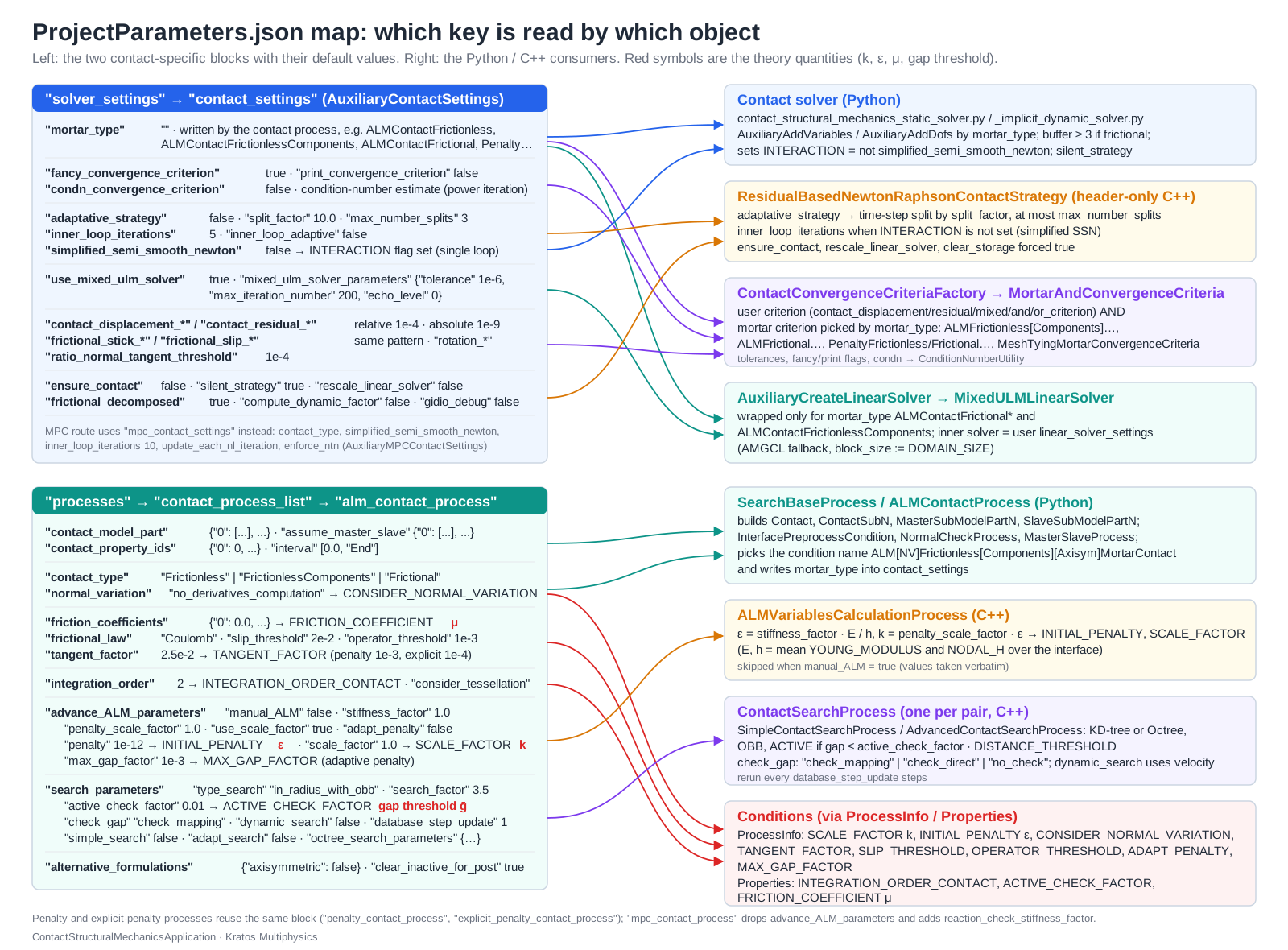
Figure: the two contact-specific JSON blocks and the Python / C++ objects that read every key.
contact_settings (static and implicit dynamic solvers)
Defaults returned by AuxiliaryContactSettings() and merged into the structural defaults by GetDefaultParameters():
{
    "contact_settings" :
    {
        "mortar_type"                                             : "",
        "condn_convergence_criterion"                             : false,
        "fancy_convergence_criterion"                             : true,
        "print_convergence_criterion"                             : false,
        "ensure_contact"                                          : false,
        "frictional_decomposed"                                   : true,
        "compute_dynamic_factor"                                  : false,
        "gidio_debug"                                             : false,
        "adaptative_strategy"                                     : false,
        "split_factor"                                            : 10.0,
        "max_number_splits"                                       : 3,
        "inner_loop_iterations"                                   : 5,
        "inner_loop_adaptive"                                     : false,
        "rotation_relative_tolerance"                             : 1.0e-4,
        "rotation_absolute_tolerance"                             : 1.0e-9,
        "rotation_residual_relative_tolerance"                    : 1.0e-4,
        "rotation_residual_absolute_tolerance"                    : 1.0e-9,
        "contact_displacement_relative_tolerance"                 : 1.0e-4,
        "contact_displacement_absolute_tolerance"                 : 1.0e-9,
        "contact_residual_relative_tolerance"                     : 1.0e-4,
        "contact_residual_absolute_tolerance"                     : 1.0e-9,
        "frictional_stick_contact_displacement_relative_tolerance": 1.0e-4,
        "frictional_stick_contact_displacement_absolute_tolerance": 1.0e-9,
        "frictional_stick_contact_residual_relative_tolerance"    : 1.0e-4,
        "frictional_stick_contact_residual_absolute_tolerance"    : 1.0e-9,
        "frictional_slip_contact_displacement_relative_tolerance" : 1.0e-4,
        "frictional_slip_contact_displacement_absolute_tolerance" : 1.0e-9,
        "frictional_slip_contact_residual_relative_tolerance"     : 1.0e-4,
        "frictional_slip_contact_residual_absolute_tolerance"     : 1.0e-9,
        "ratio_normal_tangent_threshold"                          : 1.0e-4,
        "silent_strategy"                                         : true,
        "simplified_semi_smooth_newton"                           : false,
        "rescale_linear_solver"                                   : false,
        "use_mixed_ulm_solver"                                    : true,
        "mixed_ulm_solver_parameters" :
        {
            "solver_type"          : "mixed_ulm_linear_solver",
            "tolerance"            : 1.0e-6,
            "max_iteration_number" : 200,
            "echo_level"           : 0
        }
    }
}
Key by key
| Key | Type / default | Meaning | Consumed by |
|---|---|---|---|
mortar_type |
string, "" |
Selects the formulation (see the table below). Normally written by the contact process; an empty string means “no contact”, in which case the solver behaves exactly as the structural one. | AuxiliaryAddVariables, AuxiliaryAddDofs, AuxiliarySetSettings, ContactConvergenceCriteriaFactory, AuxiliaryCreateLinearSolver, _CreateBuilderAndSolver, _CreateSolutionStrategy |
condn_convergence_criterion |
bool, false |
Estimates and prints the condition number of the system matrix at every iteration (power-iteration eigen solvers, expensive). | ContactConvergenceCriteriaFactory → MortarAndConvergenceCriteria |
fancy_convergence_criterion |
bool, true |
Prints the coloured convergence table (TABLE_UTILITY) with one column per residual and the active-set columns. |
AuxiliaryCreateConvergenceParameters |
print_convergence_criterion |
bool, false |
Verbose print of every criterion in addition to the table. | all criteria |
ensure_contact |
bool, false |
Fails the step when no node is active (a contact problem that lost contact) and runs ContactUtilities::CheckActivity at the end of each step. |
criteria constructors, ExecuteFinalizeSolutionStep |
frictional_decomposed |
bool, true |
For frictional mortar_type, use the criteria that split the contact block into stick and slip nodes (…FrictionalContactCriteria); false uses the plain displacement/LM criteria. |
ContactConvergenceCriteriaFactory |
compute_dynamic_factor |
bool, false |
Runs ComputeDynamicFactorProcess in the mortar criterion (DYNAMIC_FACTOR from the gap evolution; dynamic problems). |
BaseMortarConvergenceCriteria::PreCriteria |
gidio_debug |
bool, false |
GiD dump of flags, normals, multipliers and gaps after every iteration. | BaseMortarConvergenceCriteria::PostCriteria |
adaptative_strategy |
bool, false |
On non-convergence the time step is split (AdaptativeStep) instead of failing. |
ResidualBasedNewtonRaphsonContactStrategy |
split_factor |
double, 10.0 |
Division factor of DELTA_TIME at every split. |
idem |
max_number_splits |
int, 3 |
Maximum number of nested splits. | idem |
inner_loop_iterations |
int, 5 |
Outer iterations of the simplified semi-smooth Newton (only when simplified_semi_smooth_newton is true). |
idem |
inner_loop_adaptive |
bool, false |
Divides the time step by the current INNER_LOOP_ITERATION when the inner loop had to iterate. |
AuxiliaryComputeDeltaTime |
rotation_*_tolerance |
double | Tolerances of the rotation block (beams / shells with rotation_dofs). |
displacement/LM criteria |
contact_displacement_*, contact_residual_* |
double | Tolerances of the Lagrange-multiplier block (increment / residual). | DisplacementLagrangeMultiplier{,Residual,Mixed}ContactCriteria |
frictional_stick_*, frictional_slip_* |
double | Tolerances of the stick and slip sub-blocks of the multipliers. | …FrictionalContactCriteria |
ratio_normal_tangent_threshold |
double, 1.0e-4 |
Ratio below which the tangential multiplier is considered negligible with respect to the normal one in the frictional criteria. | idem |
silent_strategy |
bool, true |
Sets the strategy echo level to 0 (the convergence table is still printed by the criteria). | Initialize of the solver |
simplified_semi_smooth_newton |
bool, false |
false: the computing model part gets the INTERACTION flag and displacements, multipliers and active sets converge in one Newton loop (full semi-smooth Newton, thesis Algorithms 2–3). true: the sets are frozen during an inner Newton loop and re-checked up to inner_loop_iterations times. |
Initialize, ResidualBasedNewtonRaphsonContactStrategy |
rescale_linear_solver |
bool, false |
Wraps the linear solver in a ScalingSolver. |
AuxiliaryCreateLinearSolver |
use_mixed_ulm_solver |
bool, true |
Wraps the user linear solver in a MixedULMLinearSolver that condenses the dual multipliers. Applied only to vector-multiplier formulations (ALMContactFrictional*, ALMContactFrictionlessComponents). |
AuxiliaryCreateLinearSolver |
mixed_ulm_solver_parameters |
object | Settings of the mixed solver (tolerance, max_iteration_number, echo_level). |
MixedULMLinearSolver |
Forced settings and side effects
clear_storageandreform_dofs_at_each_stepare forced totrue(AuxiliaryValidateSettings): the DoF set changes with the active set.buffer_sizeis raised to at least 3 for frictional formulations (AuxiliarySetSettings), because the slip increment needs the previous configurations.AddVariablesaddsNORMAL,NODAL_H,WEIGHTED_GAP(andWEIGHTED_SLIPfor frictional types) plus the multiplier variable of the formulation;AddDofsadds the multiplier DoFs with their reactions (WEIGHTED_SCALAR_RESIDUAL,WEIGHTED_VECTOR_RESIDUAL_X/Y/Z). See the variables reference.- The computing model part receives the
INTERACTIONflag according tosimplified_semi_smooth_newton. analysis_type: "linear"with a contactmortar_typecreates the base linear strategy (no active-set iterations); use"non_linear".
mortar_type values
| Value | Formulation | Multiplier variable / DoFs | Buffer | Active-set criterion | Mixed ULM solver |
|---|---|---|---|---|---|
ALMContactFrictionless |
ALM, scalar multiplier (thesis §4.3.3.2.1) | LAGRANGE_MULTIPLIER_CONTACT_PRESSURE |
user | ALMFrictionlessMortarConvergenceCriteria |
no |
ALMContactFrictionlessComponents |
ALM, vector multiplier (§4.3.3.2.2) | VECTOR_LAGRANGE_MULTIPLIER |
user | ALMFrictionlessComponentsMortarConvergenceCriteria |
yes |
ALMContactFrictional, ALMContactFrictionalPureSlip |
ALM frictional (§4.3.4) | VECTOR_LAGRANGE_MULTIPLIER |
≥ 3 | ALMFrictionalMortarConvergenceCriteria (pure_slip for the PureSlip suffix) |
yes |
PenaltyContactFrictionless |
penalty frictionless | none | user | PenaltyFrictionlessMortarConvergenceCriteria |
no |
PenaltyContactFrictional, PenaltyContactFrictionalPureSlip |
penalty frictional | none | ≥ 3 | PenaltyFrictionalMortarConvergenceCriteria |
no |
ScalarMeshTying |
mesh tying of a scalar variable | SCALAR_LAGRANGE_MULTIPLIER |
user | MeshTyingMortarConvergenceCriteria |
no |
ComponentsMeshTying |
mesh tying of a vector variable | VECTOR_LAGRANGE_MULTIPLIER |
user | MeshTyingMortarConvergenceCriteria |
no |
The contact processes set these values from their own contact_type (Frictionless, FrictionlessComponents, Frictional, FrictionalPureSlip) and formulation (ALM / penalty / tying); see Contact process settings.
convergence_criterion
The structural key convergence_criterion accepts the contact-specific values below (built by ContactConvergenceCriteriaFactory, always combined with the mortar active-set criterion through MortarAndConvergenceCriteria):
| Value | Criterion created (ALM) | Penalty formulations | Frictional with frictional_decomposed |
|---|---|---|---|
contact_displacement_criterion |
DisplacementLagrangeMultiplierContactCriteria (displacement + LM increments) |
DisplacementContactCriteria |
DisplacementLagrangeMultiplierFrictionalContactCriteria |
contact_residual_criterion |
DisplacementLagrangeMultiplierResidualContactCriteria |
DisplacementResidualContactCriteria |
DisplacementLagrangeMultiplierResidualFrictionalContactCriteria |
contact_mixed_criterion |
DisplacementLagrangeMultiplierMixedContactCriteria (displacement residual + LM increment) |
DisplacementResidualContactCriteria |
DisplacementLagrangeMultiplierMixedFrictionalContactCriteria |
contact_and_criterion |
displacement AND residual contact criteria | idem with the penalty versions | – |
contact_or_criterion |
displacement OR residual contact criteria | idem | – |
adaptative_remesh_criteria |
the above combined with ContactErrorMeshCriteria (adaptive remeshing, needs the MeshingApplication) |
||
any structural value (displacement_criterion, residual_criterion, and_criterion, or_criterion) |
the standard structural criterion, without the multiplier blocks |
The tolerances come from the structural keys (displacement_relative_tolerance, residual_relative_tolerance, …) for the displacement block and from contact_settings for the rotation, multiplier, stick and slip blocks. Details of every criterion: Strategies and convergence criteria.
Strategy, builder-and-solver and linear solver
| Structural key | Contact behaviour |
|---|---|
solving_strategy_settings.type |
newton_raphson → ResidualBasedNewtonRaphsonContactStrategy; line_search → LineSearchContactStrategy; arc_length → the structural arc-length strategy (no contact-specific version). The MPC solvers always use ResidualBasedNewtonRaphsonMPCContactStrategy. |
builder_and_solver_settings.type |
block → ContactResidualBasedBlockBuilderAndSolver (fixes the multipliers of ISOLATED nodes); anything else → ContactResidualBasedEliminationBuilderAndSolver, or …WithConstraints when multi_point_constraints_used is true. |
linear_solver_settings |
Any Kratos linear solver. For vector-multiplier formulations it becomes the inner solver of the MixedULMLinearSolver (use_mixed_ulm_solver). When the user solver is AMGCL, the wrapper rebuilds it with block_size = DOMAIN_SIZE and the fallback below. |
time_stepping |
time_step, time_step_table or the legacy time_step_intervals; inner_loop_adaptive may reduce the step. |
AMGCL fallback used inside AuxiliaryCreateLinearSolver (the block_size is overwritten with DOMAIN_SIZE):
{
    "solver_type"                    : "amgcl",
    "smoother_type"                  : "ilu0",
    "krylov_type"                    : "lgmres",
    "coarsening_type"                : "aggregation",
    "max_iteration"                  : 100,
    "provide_coordinates"            : false,
    "gmres_krylov_space_dimension"   : 100,
    "verbosity"                      : 1,
    "tolerance"                      : 1e-6,
    "scaling"                        : false,
    "block_size"                     : 3,
    "use_block_matrices_if_possible" : true,
    "coarse_enough"                  : 1000,
    "max_levels"                     : -1,
    "post_sweeps"                    : 1,
    "pre_sweeps"                     : 1,
    "preconditioner_type"            : "amg",
    "use_gpgpu"                      : false
}
mpc_contact_settings (MPC solvers)
{
    "mpc_contact_settings" :
    {
        "contact_type"                  : "Frictionless",
        "simplified_semi_smooth_newton" : false,
        "inner_loop_iterations"         : 10,
        "update_each_nl_iteration"      : false,
        "enforce_ntn"                   : false
    }
}
| Key | Meaning | Consumed by |
|---|---|---|
contact_type |
Frictionless or Frictional (adds WEIGHTED_SLIP; the conditions get the SLIP flag). |
AuxiliaryMPCAddVariables, mpc_contact_process.py |
simplified_semi_smooth_newton |
Same meaning as for the ALM solvers (INTERACTION flag). |
ResidualBasedNewtonRaphsonMPCContactStrategy |
inner_loop_iterations |
Outer iterations of the simplified loop (default 10 here). | idem |
update_each_nl_iteration |
Re-evaluate the constraints (and rebuild the DoF set) at every non-linear iteration instead of once per step. | idem |
enforce_ntn |
Accepted for compatibility; the node-to-node enforcement (EnforcingNTN()) is commented out in the strategy and has no effect. |
– |
The MPC solvers use the elimination builder-and-solver with constraints and no MixedULMLinearSolver (there are no multiplier DoFs). See Frictional laws and MPC constraint.
contact_settings of the explicit solver
{
    "contact_settings" :
    {
        "mortar_type"                                       : "",
        "compute_dynamic_factor"                            : true,
        "ensure_contact"                                    : false,
        "silent_strategy"                                   : false,
        "delta_time_factor_for_contact"                     : 5.0e-1
    }
}
The explicit solver (contact_structural_mechanics_explicit_dynamic_solver.py) supports the penalty formulations only (explicit_penalty_contact_process.py); there is no Newton loop, so no criteria or strategies are involved. delta_time_factor_for_contact multiplies the stable time step when the CONTACT flag is set on the model part (ComputeDeltaTime).
Complete example
A frictional ALM problem with all the frequently touched keys:
"solver_settings" : {
    "solver_type"                 : "Static",
    "model_part_name"             : "Structure",
    "domain_size"                 : 3,
    "analysis_type"               : "non_linear",
    "time_stepping"               : { "time_step" : 0.05 },
    "convergence_criterion"       : "contact_residual_criterion",
    "residual_relative_tolerance" : 1.0e-5,
    "residual_absolute_tolerance" : 1.0e-9,
    "max_iteration"               : 20,
    "builder_and_solver_settings" : { "type" : "block" },
    "linear_solver_settings"      : { "solver_type" : "amgcl" },
    "contact_settings" : {
        "mortar_type"                          : "ALMContactFrictional",
        "adaptative_strategy"                  : true,
        "split_factor"                         : 5.0,
        "max_number_splits"                    : 2,
        "contact_residual_relative_tolerance"  : 1.0e-5,
        "frictional_slip_contact_residual_relative_tolerance" : 1.0e-4,
        "use_mixed_ulm_solver"                 : true
    }
}
The companion process block (contact_process_list) is documented in Contact process settings; a complete runnable case is in the tutorial.