Sources. Thesis §4.2.5 (frictional models, p. 96, Fig. 4.10), §4.3.4.1.1 (Coulomb’s law, p. 113, eqs. 4.45), App. D.5 (multipoint constraints, master–slave elimination, pp. 320–321); code:
custom_frictional_laws/frictional_law.{h,cpp},frictional_law_with_derivative.{h,cpp},coulomb_frictional_law.{h,cpp},tresca_frictional_law.{h,cpp},custom_python/add_custom_frictional_laws_to_python.cpp,custom_master_slave_constraints/contact_master_slave_constraint.{h,cpp},custom_conditions/mpc_mortar_contact_condition.{h,cpp},custom_processes/mpc_contact_search_process.cpp,custom_strategies/custom_strategies/residualbased_newton_raphson_mpc_contact_strategy.h,custom_strategies/custom_convergencecriterias/mpc_contact_criteria.h,python_scripts/mpc_contact_process.py,python_scripts/mpc_contact_structural_mechanics_static_solver.py,custom_processes/alm_fast_init_process.cpp.
This page groups two small but self-contained parts of the application. The first is the frictional law hierarchy of custom_frictional_laws/, a set of classes that encapsulate the tangential threshold \(\mathscr{F}\) of a friction model (Coulomb, Tresca) and its linearization, intended as the plug-in point for other friction models in the mortar conditions. The second is the multipoint-constraint (MPC) contact route: an alternative to Lagrange multipliers and penalties in which the mortar coupling between slave and master displacements is imposed as a Kratos MasterSlaveConstraint (ContactMasterSlaveConstraint, custom_master_slave_constraints/) that the contact search creates, the MPCMortarContactCondition updates and the builder-and-solver eliminates. Both are documented here because both are interfaces to the core machinery rather than formulations of their own: the mathematics of the frictional contact conditions is in Frictional contact, the master–slave elimination in Constrained optimisation methods.
Frictional laws
Hierarchy and interface
FrictionalLaw                                                     frictional_law.{h,cpp}              (not templated)
└── FrictionalLawWithDerivative<TDim, TNumNodes, TNormalVariation, TNumNodesMaster>
                                                                  frictional_law_with_derivative.{h,cpp}
    ├── CoulombFrictionalLaw<TDim, TNumNodes, TNormalVariation, TNumNodesMaster>
    │                                                             coulomb_frictional_law.{h,cpp}
    └── TrescaFrictionalLaw<TDim, TNumNodes, TNormalVariation, TNumNodesMaster>
                                                                  tresca_frictional_law.{h,cpp}
All classes are exported with KRATOS_API(CONTACT_STRUCTURAL_MECHANICS_APPLICATION) and compiled into the core library (custom_frictional_laws/*.cpp is one of the globs of CMakeLists.txt). The base class (frictional_law.h) is documented as “the base class for frictional laws … this class does nothing, define derived frictional laws in order to make use of it”. Its interface:
| Method | Class | Behavior |
|---|---|---|
double GetFrictionCoefficient(const Node& rNode, const PairedCondition& rCondition, const ProcessInfo& rCurrentProcessInfo) |
FrictionalLaw (virtual) |
Looks up FRICTION_COEFFICIENT in this order: rCondition.GetProperties(), the nodal non-historical data of rNode, the ProcessInfo; returns 0.0 if none has it |
double GetThresholdValue(const Node&, const PairedCondition&, const ProcessInfo&) |
FrictionalLaw (virtual) |
The tangential threshold \(\mathscr{F}\) of the node. The base implementation raises KRATOS_ERROR (“You are calling to the base class method GetThresholdValue, check your frictional law declaration”) |
double GetDerivativeThresholdValue(const Node&, const PairedCondition&, const ProcessInfo&, const DerivativeDataType& rDerivativeData, const MortarConditionMatrices& rMortarConditionMatrices, IndexType IndexDerivative, IndexType IndexNode) |
FrictionalLawWithDerivative (virtual) |
Directional derivative of the threshold of slave node IndexNode with respect to the DoF IndexDerivative of the pair condition (displacements of the slave and master nodes first, then the multipliers). The base implementation raises KRATOS_ERROR |
Info(), PrintInfo(), PrintData(), save / load |
all | Standard Kratos boilerplate (the laws are serializable) |
static constexpr double ZeroTolerance |
FrictionalLaw |
std::numeric_limits<double>::epsilon() |
FrictionalLawWithDerivative (header) introduces the template parameters of the mortar conditions and two typedefs that tie it to the derivative machinery of the Kratos core (kratos/includes/mortar_classes.h): DerivativeDataType = DerivativeDataFrictional<TDim, TNumNodes, TNumNodesMaster> (current and reference coordinates u1, X1, u2, X2, normal derivatives DeltaNormalSlave, previous multipliers) and MortarConditionMatrices = MortarOperatorWithDerivatives<TDim, TNumNodes, true, TNumNodesMaster> (the mortar operators \(\mathbf{D}\), \(\mathbf{M}\) and their directional derivatives DeltaDOperator[i], DeltaMOperator[i]). See Linearisation and derivatives for what these objects contain.
Coulomb
coulomb_frictional_law.cpp. Coulomb’s law (thesis eq. 4.45a, \(\phi_{co} := \Vert\mathbf{t}_\tau\Vert - \mu\Vert p_n\Vert \le 0\)) bounds the tangential traction by the friction coefficient times the normal pressure. In the augmented Lagrangian formulation the normal pressure of a slave node is the augmented pressure \(\bar{\lambda}_n = k\,\mathbf{n}\cdot\boldsymbol{\lambda} + \varepsilon\tilde{g}_n\) (negative in compression), so the threshold implemented by GetThresholdValue is
$$\mathscr{F}_{ALM} = -\mu\,\bar{\lambda}_n = -\mu\,\big(k\,\mathbf{n}\cdot\boldsymbol{\lambda} + \varepsilon\,\tilde{g}_n\big)$$
(thesis eq. 4.76). The code reads \(\bar{\lambda}_n\) from the nodal non-historical variable AUGMENTED_NORMAL_CONTACT_PRESSURE, which ActiveSetUtilities stores at every active-set check (see Strategies and convergence criteria); a block that recomputes it by hand from SCALE_FACTOR, INITIAL_PENALTY, VECTOR_LAGRANGE_MULTIPLIER, NORMAL and WEIGHTED_GAP is kept in the source as a comment (coulomb_frictional_law.cpp:29-40).
GetDerivativeThresholdValue linearizes \(\mathscr{F}_{ALM}\) with respect to the DoFs of the pair. Let \(n_u = d\,(n_s + n_m)\) be the number of displacement DoFs of the pair (slave nodes first, master nodes after). For IndexDerivative \(\ge n_u\) the derivative is with respect to a multiplier component; it is non-zero only for the multiplier of the node itself (aux_index / TDim == IndexNode) and equals \(-\mu\,k\,n_j\) with \(j\) the component (aux_index % TDim). For IndexDerivative \(\lt n_u\) the derivative is with respect to a displacement and only the gap term contributes:
$$\frac{\partial\mathscr{F}_{ALM}}{\partial u} = -\mu\,\varepsilon\,\frac{\partial\tilde{g}_n}{\partial u}, \qquad \frac{\partial\tilde{g}_n}{\partial u} = -\mathbf{n}\cdot\Big[\big(\mathbf{M}\,\delta\mathbf{x}_1 - \mathbf{D}\,\delta\mathbf{x}_2\big) + \big(\Delta\mathbf{M}\,\mathbf{x}_1 - \Delta\mathbf{D}\,\mathbf{x}_2\big)\Big]_{\text{row } IndexNode} - \Delta\mathbf{n}\cdot\big[\mathbf{M}\,\mathbf{x}_1 - \mathbf{D}\,\mathbf{x}_2\big]_{\text{row } IndexNode}$$
where \(\delta\mathbf{x}_1\) / \(\delta\mathbf{x}_2\) are unit perturbations of the slave / master coordinate selected by IndexDerivative (Deltax1, Deltax2), \(\mathbf{x}_1 = \mathbf{u}_1 + \mathbf{X}_1\), \(\mathbf{x}_2 = \mathbf{u}_2 + \mathbf{X}_2\) are the current coordinates from rDerivativeData, \(\Delta\mathbf{D}\), \(\Delta\mathbf{M}\) are DeltaDOperator[IndexDerivative], DeltaMOperator[IndexDerivative], and the last term (normal variation, DeltaNormalSlave[IndexDerivative]) is only added when TNormalVariation is true and the derivative is taken with respect to a slave node. Note: the source uses the mortar operators with swapped roles in the two products (prod(MOperator, Deltax1) - prod(DOperator, Deltax2) and prod(DeltaMOperator, x1) - prod(DeltaDOperator, x2)), while the weighted gap of the conditions is \(\tilde{g}_n = -\mathbf{n}\cdot(\mathbf{D}\mathbf{x}_1 - \mathbf{M}\mathbf{x}_2)\); since the class is not called by the conditions at present (see status below) this has no effect on the results.
Tresca
tresca_frictional_law.cpp. Tresca’s model uses a threshold independent of the normal pressure (“simpler because does not depend on contact normal pressure, it is just a threshold value”, thesis footnote 8 on p. 113):
$$\mathscr{F}_{Tresca} = \tau_{max}$$
GetThresholdValue looks up the application variable TRESCA_FRICTION_THRESHOLD (a double) with the same precedence as the friction coefficient (condition properties, node, ProcessInfo) and returns 0.0 when it is not found; GetDerivativeThresholdValue returns 0.0 because the threshold is constant.
Template instantiations and Python names
Each templated law is explicitly instantiated at the bottom of its .cpp for the ten combinations used by the conditions, <2,2,·,2>, <3,3,·,3>, <3,4,·,4>, <3,3,·,4>, <3,4,·,3> with TNormalVariation false and true. add_custom_frictional_laws_to_python.cpp exposes the base FrictionalLaw (default constructor, GetFrictionCoefficient, GetThresholdValue) and, through RegisterFrictionalLaws<TDim, TNumNodes, TNormalVariation, TNumNodesMaster>(m, rEndName), the classes FrictionalLaw<suffix>, TrescaFrictionalLaw<suffix> and CoulombFrictionalLaw<suffix> (default constructors only) for:
| Suffix | Template arguments | Geometry pair |
|---|---|---|
2D2N / 2D2NNV |
<2, 2, false/true, 2> |
line – line |
3D3N / 3D3NNV |
<3, 3, false/true, 3> |
triangle – triangle |
3D4N / 3D4NNV |
<3, 4, false/true, 4> |
quadrilateral – quadrilateral |
3D3N4N / 3D3N4NNV |
<3, 3, false/true, 4> |
triangle slave – quadrilateral master |
3D4N3N / 3D4N3NNV |
<3, 4, false/true, 3> |
quadrilateral slave – triangle master |
NV stands for normal variation (TNormalVariation = true), exactly as in the condition names ALMNVFrictionalMortarContactCondition… (see Conditions). Example: KratosMultiphysics.ContactStructuralMechanicsApplication.CoulombFrictionalLaw3D3NNV().
Status of the integration
The frictional-law layer is complete as a set of classes but is not yet the source of the friction coefficient used by the conditions. The top-level README.md lists “Frictional laws (WIP) in order to consider different types of frictional behaviour”. Concretely:
- The application variable
FRICTIONAL_LAW(typeFrictionalLaw::Pointer) is declared, created and registered (contact_structural_mechanics_application_variables.{h,cpp},contact_structural_mechanics_application.cpp:178), but it is not exposed to Python and no C++ or Python code reads or writes it. - The frictional conditions obtain the friction coefficient nodally:
GetFrictionCoefficient()inALM_frictional_mortar_contact_condition.h:456-467andpenalty_frictional_mortar_contact_condition.hfills a vector withr_geometry[i_node].GetValue(FRICTION_COEFFICIENT)and carries the comment// TODO: Define the "CL" or friction law to compute this. The nodal values are set byALMFastInit(alm_fast_init_process.cpp:76-112): for a frictional problem it zeroesFRICTION_COEFFICIENTandNODAL_AREAon the interface nodes, adds theFRICTION_COEFFICIENTof the properties of every condition to its nodes (warning “Friction coefficient not defined, zero will be considered” when a property lacks it) together with a counter inNODAL_AREA, and divides, so a node shared by pairs with different coefficients gets their arithmetic mean. The properties themselves receive the coefficient from thefriction_coefficientsdictionary of the contact process (alm_contact_process.py:463-476,mpc_contact_process.py:399-402), with a warning if the property already had one. - The active-set utilities (
ActiveSetUtilities::ComputeALMFrictionalActiveSet,ComputePenaltyFrictionalActiveSet) andMPCContactCriteriaalso read the nodalFRICTION_COEFFICIENTand evaluate the Coulomb threshold \(-\mu\bar{\lambda}_n\) inline, without going through aFrictionalLawobject. - The contact processes accept the key
"frictional_law" : "Coulomb"(alm_contact_process.py:70,penalty_contact_process.py:52,explicit_penalty_contact_process.py:52,mpc_contact_process.py:69) and store it inself.frictional_law, but the value is never used afterwards; only the Coulomb behavior hard-coded in the generated conditions and in the utilities is available. Note: setting"frictional_law" : "Tresca"has no effect. TRESCA_FRICTION_THRESHOLDis registered and exposed to Python, so it can be assigned to properties or nodes, but it is only read byTrescaFrictionalLaw::GetThresholdValue.
The generated frictional conditions therefore implement Coulomb friction with a nodal, possibly heterogeneous, coefficient; the FrictionalLaw classes are the intended extension point for the day the conditions delegate the threshold and its derivative (which is what the GetDerivativeThresholdValue signature, with the DerivativeData and MortarOperatorWithDerivatives arguments, is prepared for). The friction cone and the regularized Coulomb law are discussed in Frictional contact (thesis §4.2.5 and Fig. 4.10).
The MPC contact route
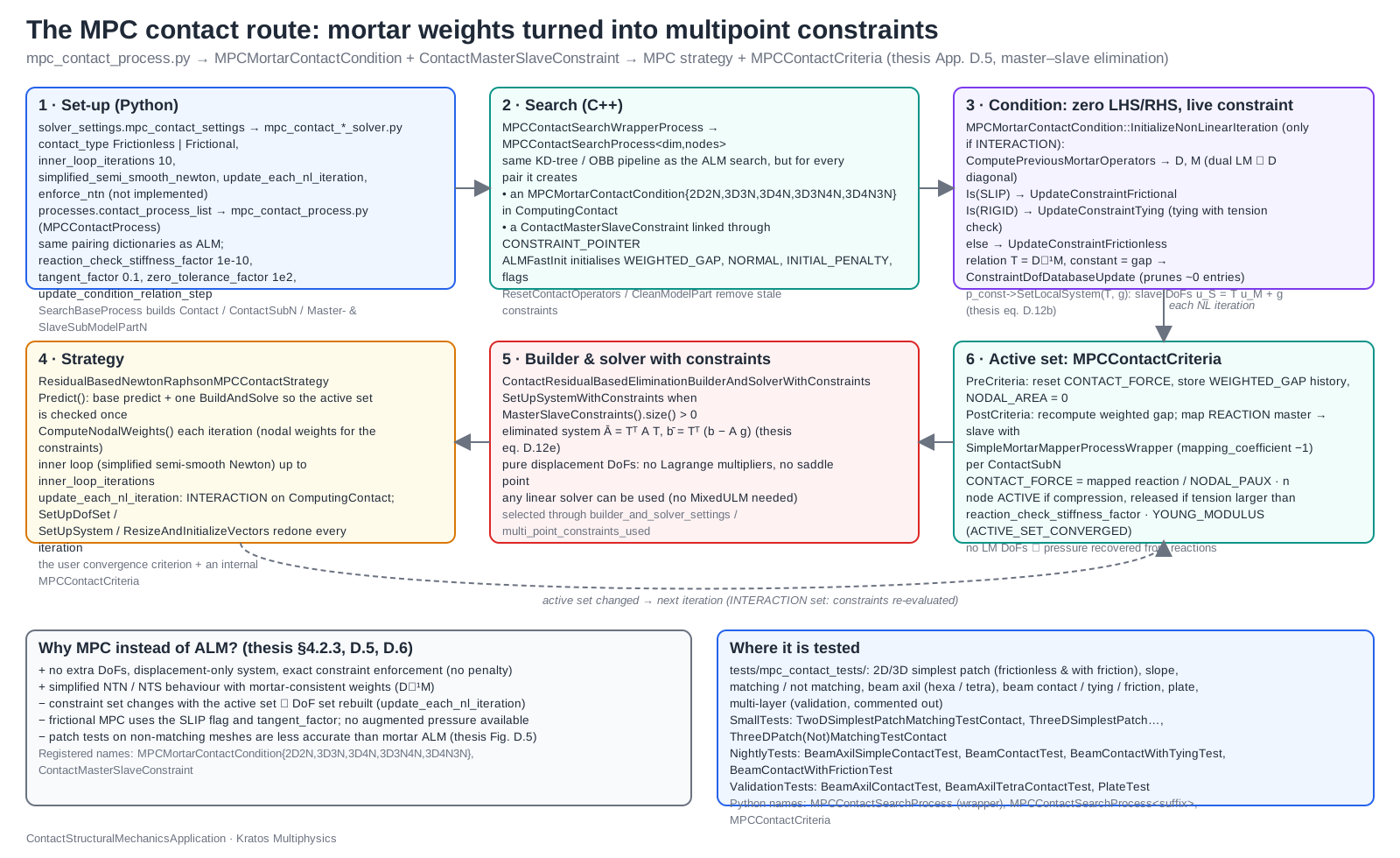
Figure: the MPC contact route from the Python settings to the eliminated system (thesis App. D.5).
In the multiplier and penalty formulations the contact condition assembles a local system. In the MPC route the same mortar operators are used to write the slave displacement as a linear function of the master displacements,
$$\mathbf{u}_{s} = \mathbf{D}^{-1}\mathbf{M}\,\mathbf{u}_{m} + \mathbf{g}, \qquad \mathbf{D}^{-1} \text{ trivial for dual multipliers},$$
and to hand this relation to the Kratos MasterSlaveConstraint machinery, which eliminates the slave DoFs at the builder-and-solver level (thesis App. D.5, “MultiPoint Constraint (Master-Slave elimination method)”, whose §D.5.3 discusses its applicability to contact). The contact inequality is then handled by activating and deactivating constraints with an active-set check based on the reactions. The route has no multipliers, no penalty and no condensation, at the price of a coarser treatment of the non-linearity (the relation matrix is frozen during the Newton iterations unless update_each_nl_iteration is set) and of a heuristic reaction-based active set. The classes involved are:
| Layer | Class | Where documented |
|---|---|---|
| Python process | MPCContactProcess (mpc_contact_process.py), derived from SearchBaseProcess |
Processes, Contact process settings reference |
| Python solver | MPCContactStaticSolver, MPCContactImplicitMechanicalSolver (mpc_contact_structural_mechanics_{static,implicit_dynamic}_solver.py), selected when solver_settings has mpc_contact_settings |
Solver settings reference |
| Search | MPCContactSearchProcess<TDim, TNumNodes, TNumNodesMaster> and MPCContactSearchWrapperProcess |
Search pipeline and bounding volumes |
| Condition | MPCMortarContactCondition<TDim, TNumNodes, TNumNodesMaster> (MPCMortarContactCondition2D2N, 3D3N, 3D4N, 3D3N4N, 3D4N3N) |
Conditions, this page |
| Constraint | ContactMasterSlaveConstraint |
this page |
| Strategy and criterion | ResidualBasedNewtonRaphsonMPCContactStrategy, MPCContactCriteria |
Strategies and convergence criteria |
| Builder-and-solver | Core ResidualBasedBlockBuilderAndSolver (default) or ResidualBasedEliminationBuilderAndSolverWithConstraints; the contact-specific ContactResidualBasedEliminationBuilderAndSolverWithConstraints is selected by the mortar-based solvers |
Builder and solvers and linear solvers |
ContactMasterSlaveConstraint
contact_master_slave_constraint.h / .cpp. The only class of custom_master_slave_constraints/; it derives from the core LinearMasterSlaveConstraint (BaseType, whose own base is MasterSlaveConstraint) and is registered as "ContactMasterSlaveConstraint" in KratosContactStructuralMechanicsApplication::Register() (KRATOS_REGISTER_CONSTRAINT). A linear master–slave constraint stores a list of slave DoFs, a list of master DoFs, a relation matrix \(\mathbf{T}\) and a constant vector \(\mathbf{c}\), meaning \(\mathbf{u}_{slave} = \mathbf{T}\,\mathbf{u}_{master} + \mathbf{c}\). The contact version adds nothing to the data; its purpose is to be a distinct type that the search can create, the condition can update and the criterion can (de)activate.
| Member | Behavior |
|---|---|
ContactMasterSlaveConstraint(IndexType Id = 0) |
Empty constraint, the one created by the search |
ContactMasterSlaveConstraint(Id, rMasterDofsVector, rSlaveDofsVector, rRelationMatrix, rConstantVector) |
Full constructor forwarding to LinearMasterSlaveConstraint |
ContactMasterSlaveConstraint(Id, rMasterNode, rMasterVariable, rSlaveNode, rSlaveVariable, Weight, Constant) |
Single-component constructor; always throws KRATOS_ERROR (“Please don’t use this constructor. A components variable is expected”) |
Create(...) (two overloads) |
Return Kratos::make_shared<ContactMasterSlaveConstraint> with the same arguments |
FinalizeNonLinearIteration(const ProcessInfo&) override |
Empty body (contact_master_slave_constraint.cpp:115-118); the update of the relation is driven by the condition, not by the constraint |
GetInfo() |
Returns "This is contact MPC !"; PrintInfo writes the class name and id |
save / load |
Serialize through the base class |
The relation of a constraint is (re)written from outside with the inherited SetDofList(rSlaveDofsVector, rMasterDofsVector, rCurrentProcessInfo) and SetLocalSystem(rRelationMatrix, rConstantVector, rCurrentProcessInfo); its participation in the system is controlled with the ACTIVE flag, which the builder-and-solver honors.
Creation and attachment: MPCContactSearchProcess
MPCContactSearchProcess (mpc_contact_search_process.cpp) derives from BaseContactSearchProcess and runs the same KD-tree / OBB search as the other formulations (see Search pipeline and bounding volumes); its overrides deal with the constraints:
AddPairing(lines 113-145) creates the pair condition through the base class (the condition name isMPCMortarContact+Condition+ dimension/node suffix, fromMPCContactProcess._get_condition_name), then aContactMasterSlaveConstraintwith idGetMaximumConstraintsIds() + 1, sets itACTIVE, initializes it, adds it to the computing model part and stores its pointer in the condition withp_cond->SetValue(CONSTRAINT_POINTER, p_new_const). The condition inherits the problem type from the main model part flags:SLIPif the main model partIs(SLIP)(frictional),RIGIDif itIs(RIGID)(mesh tying through constraints), nothing for frictionless contact. Finallyp_cond->Initialize(r_process_info)builds the first relation (see below).CheckContactModelParts(lines 48-108) clones the constraints of theContactsub-model-part that carry theMARKERflag with new ids (so that a constraint that survives a remeshing is not shared between the old and new sub-model-parts) and marks the others, removing theTO_ERASEones.CleanModelPart(lines 149-160) flags all constraints of the given model partTO_ERASEand removes them from all levels;ResetContactOperators(lines 184-260) does the same for the constraints of theComputingContact(Sub<id>)model part after a remeshing (MODIFIED), or removes only the constraints of the pairs that disappeared, using theINDEX_MAPof every master node.
CONSTRAINT_POINTER is an application variable of type MasterSlaveConstraint::Pointer registered in contact_structural_mechanics_application_variables.h; it is not exposed to Python (see the Variables and flags reference).
Update: MPCMortarContactCondition
mpc_mortar_contact_condition.cpp. The condition derives directly from PairedCondition (not from MortarContactCondition), has MatrixSize = TDim * (TNumNodes + TNumNodesMaster) and assembles nothing: CalculateLeftHandSide and CalculateRightHandSide (lines 351-410) resize and zero the local system, CalculateMassMatrix / CalculateDampingMatrix likewise. Its role is to keep the constraint attached through CONSTRAINT_POINTER up to date with the current geometry. The same update block appears three times:
| Hook | When the constraint is rebuilt |
|---|---|
Initialize (lines 78-121) |
Always, right after the search created the pair (with an empty auxiliary ProcessInfo) |
InitializeSolutionStep (lines 125-172) |
At the beginning of every time step unless the condition Is(BLOCKED). MPCContactProcess.ExecuteFinalizeSolutionStep sets BLOCKED on all conditions when update_condition_relation_step is false (the default), so by default the relation is computed once, at the step in which the pair is created; with update_condition_relation_step = true it follows the deformation step by step. For frictional conditions the previous mortar operators are stored here the first time (mPreviousMortarOperatorsInitialized) |
InitializeNonLinearIteration (lines 176-216) |
At every Newton iteration, only if the condition Is(INTERACTION), which ResidualBasedNewtonRaphsonMPCContactStrategy::AuxiliarySolveSolutionStep sets from update_each_nl_iteration |
The block itself:
MortarExplicitContributionUtilities<TDim, TNumNodes, FRICTIONLESS_PENALTY, false, TNumNodesMaster>::ComputePreviousMortarOperators(this, rCurrentProcessInfo, mortar_operators, integration_order, false)integrates the mortar operators \(\mathbf{D}\) and \(\mathbf{M}\) of the pair on the current configuration (INTEGRATION_ORDER_CONTACTfrom the properties, default 2) and returns whether dual shape functions were used (dual_LM).- A relation matrix of size
TDim * TNumNodes × TDim * TNumNodesMasterand a constant vector of sizeTDim * TNumNodesare zeroed and filled byUpdateConstraintFrictional(conditionIs(SLIP)),UpdateConstraintTying(conditionIs(RIGID)) orUpdateConstraintFrictionless(otherwise). ConstraintDofDatabaseUpdateprunes the relation and rebuilds the DoF lists of the constraint.p_const->SetLocalSystem(relation_matrix, constant_vector, rCurrentProcessInfo)stores the new relation.
UpdateConstraintFrictionless (lines 593-710). With \(\mathbf{D}\) and \(\mathbf{M}\) from the mortar operators, \(\mathbf{D}^{-1}\) is the trivial diagonal inverse when dual_LM is true and a full MathUtils::InvertMatrix otherwise; the product \(\mathbf{D}^{-1}\mathbf{M}\) (D_inv_M, TNumNodes × TNumNodesMaster) is the mortar projection of master onto slave nodes. Any row of \(\mathbf{D}^{-1}\mathbf{M}\) with an entry below \(-10^{-8}\) is zeroed entirely (a negative weight means the slave node projects outside the master, “not in the same section”). Then, for every active slave node \(i\) (IsActive()), with \(w_i = 1/\)NODAL_PAUX (the inverse of the number of pair conditions sharing the node, computed by the strategy’s ComputeNodalWeights, so that a node shared by several pairs receives the average of their relations) and \(\mathbf{n}_i\) the nodal normal, the normal components are coupled:
$$T_{(i,a),(j,b)} = w_i\, n_{i,a}\, n_{i,b}\,\big(\mathbf{D}^{-1}\mathbf{M}\big)_{ij}, \qquad a, b = 1..d,\ j = 1..n_m$$
(entries with \(\vert T\vert \le 10^{-12}\) are not written). This is a normal-only constraint: the slave node is free to move tangentially, which is what frictionless contact requires. The constant vector carries the gap that must be closed. The nodal gap is \(g_i = \tilde{g}_{n,i}/\)NODAL_AREA (the weighted gap normalized by the nodal area, both accumulated by ComputeExplicitContributionConditions), corrected by the previous displacements so that the constraint is written in terms of total displacements: \(g_i \leftarrow g_i + \mathbf{n}_i\cdot\big[\mathbf{u}_1^{n-1} - \mathbf{D}^{-1}\mathbf{M}\,\mathbf{u}_2^{n-1}\big]_i\) (u1_0, u2_0 are DISPLACEMENT at buffer position 1), and
$$c_{(i,a)} = w_i\, g_i\, n_{i,a}.$$
A variant that computes the gap from the positions instead of the previous displacements is kept as a comment. Inactive slave nodes get zero rows, which ConstraintDofDatabaseUpdate then removes.
UpdateConstraintFrictional (lines 716-826). Same \(\mathbf{D}^{-1}\mathbf{M}\) and same constant vector; the relation matrix depends on the frictional state of each active slave node: a SLIP node receives the normal-only coupling above (comment: // SLIP // TODO: Add nodal forces), a stick node receives the full vector coupling
$$T_{(i,a),(j,a)} = w_i\,\big(\mathbf{D}^{-1}\mathbf{M}\big)_{ij}, \qquad a = 1..d$$
(comment: // STICK // TODO: ADD the contribution of slip to constant vector), which glues the slave node to the master surface in all directions. Note: the frictional MPC route therefore treats stick exactly and slip as frictionless (no tangential force is imposed on slipping nodes); the SLIP flag is toggled by MPCContactCriteria from the mapped reactions and the nodal FRICTION_COEFFICIENT, and the FrictionalLaw classes are not involved.
UpdateConstraintTying (lines 832-925). Used when the main model part Is(RIGID), that is when mpc_contact_settings.contact_type / the process contact_type contains MeshTying: the full vector coupling of the stick case is written for every active slave node without looking at SLIP, and the same gap-based constant vector is built. Since the active set of MPCContactCriteria still applies (RIGID is only checked when the problem is not frictional), the tying constraint is released for nodes whose reaction is in traction; this is the “tying with tension check” of the flowchart above.
ConstraintDofDatabaseUpdate (lines 466-587). The relation matrix produced above has many zero rows (inactive slave nodes, tangential components in the frictionless case) and possibly zero columns (master nodes with no projection). A constraint with zero rows would declare slave DoFs that are not actually constrained, so the method computes the sum of absolute values of every row and column, keeps only the rows (slave_dofs_OK) and columns (master_dofs_OK) whose sum exceeds \(10^{-4}\), rebuilds a dense relation matrix and constant vector of the reduced size, and builds the matching slave and master Dof lists (DISPLACEMENT_X, _Y and, in 3D, _Z of the parent and paired geometries, in the same order as the rows/columns). Finally p_const->SetDofList(slave_dof_vector, master_dof_vector, rCurrentProcessInfo). When nothing was pruned the full lists are used. A commented-out block shows an earlier design in which the slave DoFs were also listed as masters (identity rows for inactive nodes), which was abandoned in favor of pruning.
Two further details of the condition: AddExplicitContribution (lines 447-462) calls MortarExplicitContributionUtilities::AddExplicitContributionOfMortarCondition (or the frictional variant with the previous operators) so that WEIGHTED_GAP, WEIGHTED_SLIP and NODAL_AREA are accumulated exactly as in the other formulations — this is what MPCContactCriteria::PreCriteria / PostCriteria and the strategy’s Predict rely on; and ComputePreviousMortarOperators (lines 935-940) stores \(\mathbf{D}^{n-1}\), \(\mathbf{M}^{n-1}\) for the slip computation of frictional problems (called in InitializeSolutionStep and FinalizeSolutionStep).
Activation, deactivation and the tension check
MPCContactCriteria::PostCriteria (see Strategies and convergence criteria) maps the master REACTION onto the slave nodes, computes for every slave node the normal contact pressure \(p_n = (\mathbf{R}\cdot\mathbf{n})/\)NODAL_MAUX and the normalized gap \(g = \tilde{g}_n/\)NODAL_AREA, and declares the node active when
$$p_n \lt -\,\texttt{REACTION\_CHECK\_STIFFNESS\_FACTOR}\cdot E \quad\text{or}\quad g \lt 0$$
where \(E\) is the YOUNG_MODULUS of the first element properties. The factor (default \(10^{-10}\) from mpc_contact_settings, written to ProcessInfo[REACTION_CHECK_STIFFNESS_FACTOR] by MPCContactProcess._initialize_process_info) turns the reaction check into a relative one: a slave node stays active while its reaction pushes into the master with a pressure larger than a tiny fraction of the stiffness, or while it penetrates; it is released when the constraint would have to pull the node (tension). A pair condition whose slave nodes are all inactive is set inactive together with its constraint (p_const->Set(ACTIVE, false)), so that the builder-and-solver ignores it in the next assembly; the strategy re-runs ComputeNodalWeights before every iteration and, with update_each_nl_iteration, SetUpDofSet / SetUpSystem, because the number of eliminated DoFs changes with the active set. Nodes are re-activated by the same test in the next PostCriteria; the loop converges when no node changes status (and, for frictional problems, when no node changes between stick and slip).
End to end
- Settings.
solver_settings.mpc_contact_settings(contact_type,simplified_semi_smooth_newton,inner_loop_iterations= 10,update_each_nl_iteration,enforce_ntn) selectsMPCContactStaticSolver/MPCContactImplicitMechanicalSolverthrough the structural solver wrapper;processes.contact_process_listholds anmpc_contact_process(MPCContactProcess) with the same pairing dictionaries as the ALM process plusreaction_check_stiffness_factor,tangent_factor,zero_tolerance_factor,frictional_law(accepted, unused) andupdate_condition_relation_step. - Set-up (Python).
MPCContactProcess.ExecuteInitializecreates theContact,ContactSub<key>,MasterSubModelPart<key>andSlaveSubModelPart<key>model parts, setsSLIP(frictional) orRIGID(mesh tying) on the main model part, writesREACTION_CHECK_STIFFNESS_FACTOR,TANGENT_FACTOR,ACTIVE_SET_CONVERGEDand the search parameters to theProcessInfo, runsALMFastInit(normals,WEIGHTED_GAP, friction coefficients) and creates oneMPCContactSearchProcessper pair (_create_main_search). - Search (C++). At every step (
database_step_update)MPCContactSearchProcessclears the stale pairs and constraints and, for every new slave–master pair, creates anMPCMortarContactConditioninComputingContactand aContactMasterSlaveConstraintlinked throughCONSTRAINT_POINTER;Initializeof the condition writes the first relation. - Solve.
ResidualBasedNewtonRaphsonMPCContactStrategypredicts, computes the nodal weights, and runs the Newton loop;MPCMortarContactCondition::InitializeSolutionStep/InitializeNonLinearIterationrefresh the relations, the builder-and-solver eliminates the slave DoFs, andMPCContactCriteria(both the strategy’s internal one and the one in the userAndCriteria) updates the active set from the reactions until it is stable. - Finalize.
MPCContactProcess.ExecuteFinalizeSolutionStepblocks the conditions (unlessupdate_condition_relation_step), resets theSLIPflags of inactive nodes for post-processing and the search removes the pairs that are no longer close.
The tests of this route are in tests/mpc_contact_tests/ (beam_contact_static_test, beam_contact_static_with_friction_test, plate_test with contact_type MeshTying, 3D_multi_contact_test, …, see the Test suite reference); they use the default block builder-and-solver of the structural solver. For the theory of the master–slave elimination and its comparison with penalty and Lagrange multipliers see Constrained optimisation methods; for the mortar operators \(\mathbf{D}\) and \(\mathbf{M}\) that make \(\mathbf{D}^{-1}\mathbf{M}\) cheap see Mortar integration and dual Lagrange multipliers.
Quick reference
| Item | Value |
|---|---|
| Frictional law classes | FrictionalLaw, FrictionalLawWithDerivative<…>, CoulombFrictionalLaw<…>, TrescaFrictionalLaw<…> (10 instantiations each) |
| Python names | FrictionalLaw, FrictionalLaw<S>, CoulombFrictionalLaw<S>, TrescaFrictionalLaw<S> with S in 2D2N, 3D3N, 3D4N, 3D3N4N, 3D4N3N and the NV versions |
| Coulomb threshold | \(-\mu\,\bar{\lambda}_n\), \(\bar{\lambda}_n\) read from AUGMENTED_NORMAL_CONTACT_PRESSURE |
| Tresca threshold | TRESCA_FRICTION_THRESHOLD (properties → node → ProcessInfo) |
| Friction coefficient lookup | FRICTION_COEFFICIENT (properties → node → ProcessInfo) in the law; nodal value averaged by ALMFastInit in the conditions |
| Unused hooks | FRICTIONAL_LAW variable, frictional_law JSON key |
| Constraint class | ContactMasterSlaveConstraint (registered "ContactMasterSlaveConstraint"), empty FinalizeNonLinearIteration |
| Attachment | condition.SetValue(CONSTRAINT_POINTER, constraint) in MPCContactSearchProcess::AddPairing |
| Relation | \(\mathbf{T} = w\,(\mathbf{n}\otimes\mathbf{n})\,\mathbf{D}^{-1}\mathbf{M}\) (frictionless, slip) or \(\mathbf{T} = w\,\mathbf{D}^{-1}\mathbf{M}\otimes\mathbf{I}\) (stick, tying); \(\mathbf{c} = w\,g\,\mathbf{n}\) |
| Pruning thresholds | Row/column sum \(\gt 10^{-4}\) kept; entries \(\gt 10^{-12}\) written; rows with an entry \(\lt -10^{-8}\) in \(\mathbf{D}^{-1}\mathbf{M}\) zeroed |
| Active-set test | \(p_n \lt -\texttt{REACTION\_CHECK\_STIFFNESS\_FACTOR}\cdot E\) or \(g \lt 0\) |
| Relation update frequency | Once per pair (default), per step (update_condition_relation_step), per iteration (update_each_nl_iteration) |